
JLT elections
I’m so proud of Year 4!
Today we were blown away by lots of persuasive JLT speeches! The children used great courage and empathy to present the reasons why their peers should vote for them to be a member of the JLT. It must have been a very hard decision for voters given the quality of the candidates!

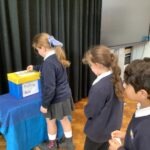
We really enjoyed reflecting on how our JLT election has its roots in democracy which was created in Athens during the Golden Age of Ancient Greece.
The new JLT members will be announced in Collective Worship tomorrow and Mr Nash is excited to hear all of their suggestions.
Living and learning – protected characteristics
This week, Year 4 have continued learning about protected characteristics and why they are so important.
Protected characteristics are parts of a person’s identity such as their age, disability, race, religion or sex that are protected by law.

We discovered that the law helps protect people from being treated unfairly because of who they are. We discussed examples of when people might need to be protected and how everyone deserves to be treated with compassion and respect. We thought about what we could do if we felt like we were being treated unfairly or if we saw someone else being treated unfairly.
Help at home: If you would like to discuss protected characteristics with your child at home, this website would be a great way to facilitate discussions and further reflections https://www.bbc.co.uk/bitesize/articles/z8yjdp3#zqjgr2p
Writing – The return of the Ancient Greek soldier
This week, the children have written a recount from the point of view of an Athenian warrior returning home and marching through the streets of Athens.
The children have been focusing on:
- prepositions
- adverbs
- writing in the past tense
- using capital letters and full stops
- using their best handwriting
It has been a joy to read their work. Here are some fantastic quotes from their recounts:
Here are some quotes from their work:
I saw an eagle in the sky quickly scavenging for food. Jack H
As I stepped off the boat, I gazed at the crackling fire between the magnificent statues towering above me. Willow
My heart pounded loudly as the warm feeling of coming home came rushing into me. Woody
Well done, Year 4.
Help at home by looking at the BBC Bitesize website grammar pages. This will help to reinforce learning about the different word classes including prepositions and adverbs.
Spellings to be tested Friday 16th October
Drop the y for an i
Spelling rule:
When a word ends in y, we often change the y to i before adding a suffix.
Remember: y → i before adding the suffix
e.g.
carry → carried
easy → easily
happy → happily
Can you spot where the y has changed to an i?
Spellings to learn that use this rule:
1. happily
2. happier
3. happiest
4. easily
5. easier
6. carried
7. worried
8. copied
9. tried
10. cried
Spellings – to be tested 1st October
Two-Syllable Words Containing Double Consonants
Spelling rule:
Some two-syllable words contain double consonants. Look carefully at the middle of the word and listen for the short vowel sound.
This week’s words:
1. address
2. different
3. difficult
4. opposite
5. possible
6. occasion
7. occasionally
8. suppose
9. appear
10. disappear
Remember:
Look carefully for the double consonant in the middle of the word.
For example:
– different
– difficult
– opposite
– possible
Can you spot the double consonant in each word?
Living and Learning – I know that rights come with responsibilities
This week’s Living and Learning lesson was about rights and responsibilities.
Rights are moral or legal entitlements to have or do something.
“She had every right to be angry.”
“You are within your rights to ask for your money back.”
We have the right to be educated, to be loved and respected, to relax and to play.
A responsibility is an obligation to behave correctly.
We have the responsibility to listen in school, to love and respect others, to relax and play safely.
We discussed how having the right to something also meant that we had a matching responsibility. These two posters below are excellent examples of this.

Spellings to be tested Friday 2nd October
Two-Syllable Words Containing Double Consonants
Spelling rule:
Some two-syllable words contain double consonants. Look carefully at the middle of the word and listen for the short vowel sound.
This week’s words:
1. address
2. different
3. difficult
4. opposite
5. possible
6. occasion
7. occasionally
8. suppose
9. appear
10. disappear
Remember:
Look carefully for the double consonant in the middle of the word.For example:
– different
– difficult
– opposite
– possible
Can you spot the double consonant in each word?
History – When was Ancient Greece?
This week in history, we have been learning about when the Golden Age of Ancient Greece took place. We worked together to create a large timeline using multilink cubes, placing and labelling some of the important people, events and periods we have already explored in our history lessons.
The children thought that the coronavirus felt like a long time ago so seeing the timeline stretched out in front of us helped us understand chronology and showed us just how long ago the Ancient Greeks lived.
The children were amazed by how far back in history we had to travel to reach Ancient Greece!
Help at home: Can you create your own mini timeline? Include Ancient Greece (800-300 BC) alongside other significant dates for you as a family (this could be the year that family members were born and any other historical events or eras that you find interesting.)

PE – team building
This half term, our focus sport in PE is hockey.
Before getting stuck into developing our hockey skills, we’ve spent some time building our teamwork and communication skills. Over the past couple of weeks, the children have taken part in a range of challenges that have encouraged them to listen carefully, take turns, think strategically and reflect on the decisions they’ve made.
To round off this mini block of learning, the children have designed their own teamwork challenges for their friends to tackle. It has been fantastic to see them putting their communication, creativity and teamwork skills into practice!


Help at home: When working together on a task, take some time to talk about what went well and what could have gone better. Encourage your child to reflect and connect about how they feel when things go well, as well as when things don’t go as planned. This can help them develop confidence, resilience and an understanding of their emotions.
Times Tables information session
Thank you to the parents who were able to join me after school for the times tables information session.

If you weren’t able to come but would like to know about the times tables check that your child will complete at the end of Year 4 please let me know.