Maths: Wholes and Parts

In maths we are learning about wholes and parts.  The children have started by learning how wholes are made up of parts.

_______ is a part. _______ is a part. The whole is _______.

Using counters the children were able to identify that two parts make a whole.

With practise, the class will start to represent parts and wholes using part whole models.

Help at home

Ask your children simple questions about parts and wholes:

If 3 is a part and 2 is a part, what is my whole?


Castles and Cannonballs in PE!

This term in PE, Year 1 have been working hard on developing their construction, teamwork, and bowling skills! We’ve had so much fun building castles out of cones in teams. The children showed fantastic collaboration as they carefully planned and built their castles, making sure they were sturdy and creative.

Once the castles were complete, it was time for some excitement – knocking them down with “cannonballs”! Using dodgeballs, the children practiced their aiming and bowling skills, focusing on throwing with power and accuracy. They absolutely loved the challenge of taking down the castles and cheering on their teammates.

Through this activity, Year 1 have not only improved their physical skills, but also learned the importance of communication and teamwork. It’s been wonderful to see how well they’ve supported each other and celebrated each other’s successes!

Maths Fun with One More and One Less!

This week in Year 1, we’ve been busy learning about 1 more and 1 less. Using ten frames and colourful maths cubes, the children explored adding or taking away 1 from different numbers. They enjoyed using the cubes to build numbers and then adding or removing cubes to see how the number changes.

Well done, Year 1 – you’re becoming fantastic mathematicians! Keep practising your 1 more and 1 less at home!

Help at Home

To support our maths learning, challenge your children with 1 more and 1 less questions at home. Try asking:

  • “What is one more than 5?”
  • “What is one less than 10?”

These simple questions will help build their confidence and understanding. Keep it fun and encourage them to explain their thinking!

Reading and Writing: Little Red

In English, we have been having lots of fun exploring the story Little Red by Bethan Woollvin! The children have enjoyed comparing this modern version to the original Little Red Riding Hood fairy tale. We’ve had lots of great discussions about the differences in characters and storylines.

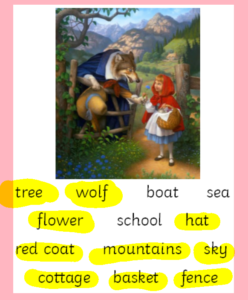
We have also started learning about nouns. A noun is a word that names a person, place, or thing. For example, in Little Red, the girl is a person, the woods are a place, and the basket is a thing. The children have been looking at different pictures and practicing identifying nouns in them. They are really getting the hang of it!

Soon, we will be using these nouns to create sentences!


We Are Scientists!

Welcome back! We’ve had an exciting start to the school year in Science.

This week, the children were introduced to the topic of Science itself, discussing what it means to be a scientist and why understanding the world around us is important. We explored how science helps us ask questions, make observations, and carry out experiments to discover new things.

Our first unit of the term is all about the human body. The children began by identifying different parts of the body. To put their new knowledge into practice, we conducted a fun experiment where the children compared their height, foot size, and age. The goal was to see if there’s a relationship between these measurements.

The class had a great time measuring each other’s feet and heights and noting down their findings. It sparked interesting discussions about growth, and the children enjoyed thinking like scientists!

First Aid Workshop in Year 1

This week we were lucky enough to have a visit from an experienced first aider. The children discussed what they thought first aid was and when they might need to use it.

Many of the children reflected on incidents that have happened and discussed how first aid was administered. We talked about who the first aiders are at school and when we might need to approach them.

The trainer introduced the children to dummies on which they could practice their first aid. Each child was able to rehearse what they should do if they found someone in need. They were taught to follow these steps:

  • Shout for help / alert a near by adult.
  • Check to see if the individual is awake.
  • Check to see if the individual is breathing.

The children also practiced applying a plaster to the dummy.

By the end of the session the children were confident that they would know what to do if another person was in need.