Reading – Authorfy

Year 4 LOVE Authorfy!

Year 4 may have mentioned special challenges and videos with authors that they’ve enjoyed in Book Club.  Highlights so far have included:

  • understanding more about why Onjali Rauf writes the books she writes by listening to her Q&A videos.
  • designing our own laser-inspired level in response to a challenge set by 13 story treehouse author Andy Griffiths (see photo below).
  • creating our own front cover design to Barb the Brave.
13-Storey Treehouse Challenge in Book Club

Rumour has it that to celebrate the National Year of Reading in 2026, Authorfy will be making many of their resources free to families to access at home. You can read more about the National Year of Reading here.

Topic – Art – Colours

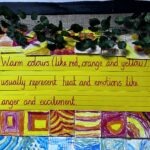
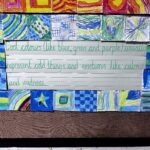
We’re looking forward to welcoming you in to class on Friday (28th November) for our Topic Review.  When you come in, we can’t wait to share with you what we have learned about complementary, warm and cool colours.

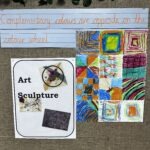
You’ll see some of our work so far on our Art Working Wall. Here is a sneaky peek:

Help at home: Look at these pieces of art shared by the Tate – can you see how the artists have used complementary colours? Tate – Complementary Colours

In class we’ve learned that complementary colours are opposite each other on the colour wheel. This paragraph (taken from the Tate) provides another interesting observation that your child might want to explore.

In colour theory complementary colours appear opposite each other on colour models such as the colour wheel. The colour complement of each primary colour (primaries are red, yellow and blue) can be obtained by mixing the two other primary colours together. So the complementary of red is green (a mix of yellow and blue); the complementary of blue is orange (a mix of red and yellow); and the complementary of yellow is violet (a mix of red and blue).


L&L – Anti-bullying week

Earlier this week, Year 4 took part in Odd Socks Day as part of Anti-bullying Week.

What is bullying?

We started by talking about what bullying actually means and how it is different from being rude or mean. We learned that:

  • Being rude is when someone says or does something hurtful, as a one-off and is unintentional.

  • Being mean is when someone hurts another on purpose, as a one-off and is intentional.

  • Bullying is when someone hurts someone, intentionally several times on purpose.

What can we do?

We discussed what we should do if we see someone being bullied including:

  • tell a trusted adult,
  • stand up for others safely, and
  • be kind to everyone.

We learned about the different roles people can take in a situation where someone is being bullied. You can learn more about this here: Anti-bullying Alliance video

The children shared excellent ideas about how they can help make our school a happy and healthy place for all.

STOP

Year 4 showed wonderful compassion during our discussions showing that they truly understand that kindness and respect matter everywhere all the time.

Help at home: Together, watch the video about the different roles in bullying situations. Discuss what bullying is and what your child should do if they’re being bullied or think someone else is either in person or online.

Me & My Money Week

Our first week back has been jam packed with new and exciting learning! This week has been one of our themed weeks all about money! We’ve had a variety of sessions where we’ve learnt a lot about money, different ways to pay for things, saving, fundraising for charity, how our values and advertising can impact our decision making and the cost of everyday items. We can’t wait to show you all of our learning when you come in for our Topic Review on 28th November.

A trip to Antarctica

One of the most fun sessions was an online live lesson offered by HSBC where we planned a trip to Antarctica thinking about the difference between our wants and our needs. We had a budget to stick to and it was tough making decisions between our competing wants.

Help at home – the children were shocked to learn the average monthly cost of household expenses such as electricity and food shopping. Next time you go food shopping, you could challenge your child to use a calculator to add the cost of the food as you put it in your trolley. If they want a bigger challenge, they could use rough prices and add the amounts in their head.

Geography – Fieldwork and application of what we have learned to our local area

We have concluded our Geography learning for this half-term with some field work to investigate how land is used in Wetherby.

The children were excellent at identifying the different uses including: commercial, residential, recreational and transport.  We were disappointed not to find any land being used for agricultural purposes near our school.

Later in the week, we were inspired by Poppy’s news that people who live near her have petitioned the council to preserve the use of land for agricultural purposes.  We each decided what we thought the land should be used for and shared our views with the rest of the class.

Help at home: you could take a walk in your local area and see if you can find examples of the different land uses.  Here are some examples we found when doing our field work to inspire you.


Science – Getting excited about states of matter – lava lamps

Next half term, our learning in science will be about states of matter.  To kick our learning off with a bang (metaphorical rather than actual this time) we made lava lamps today.

We discussed how the different densities of the liquids meant that oil and water separated when poured into the same container.

After we added food colouring, we added an effervescent tablet (and enjoyed the challenge of saying effervescent!) The resulting reaction generated lots of awe and wonder from Year 4.  You can see some examples of what we saw below:

We discussed how we had to stay safe by leaving the lid off the jar so the gas could escape and not create pressure which might cause the jar to shatter.

I know lots of children would like to recreate the activity at home, you can find full details here: Instructions to make a lava lamp

Help at home: If you enjoy experimenting at home, you can find lots of ideas here: Science at home

JLT elections

With 14 strong candidates for the two positions of Year 4 JLT representatives, it was always going to be a tough decision for our voters!

Today, many courageous Year 4 children spoke confidently to their peers explaining why they would be a great leader. All children presented persuasive and coherent arguments for why they should be chosen.

As a democracy, each child had one vote which they cast in private in the voting booth. This was then submitted anonymously in the polling box.

I am incredibly proud of all the children who nominated themselves for JLT as well as all the children who showed respect when listening to the speeches. Seeing this group of incredible young people makes me think our future is in safe hands!

Living & Learning – Protected characteristics

Our Living & Learning statement this week was:

I understand some characteristics are protected by law.

This week we learnt about the protected characteristics. We discussed what they are and how and why they’re protected.

What is discrimination?

Discrimination is defined as ‘the unfair treatment of people because of who they are or because they have a certain characteristic(s)’. We discussed examples and the impact of discrimination.

Protection from discrimination

We discussed how the protected characteristics are protected by law – The Equality Act 2010 protects people from discrimination based on protected characteristics.

We reminded ourselves of a helpful way to remember the protected characteristics by using the mnemonic:

DR GRAMPSS

Disability

Race

Gender reassignment

Religion or beliefs

Age

Marriage or civil partnership

Pregnancy and/or maternity leave

Sex

Sexual orientation

We are already pretty confident recalling the protected characteristics so we thought deeper about why they are important.  What would our world be like if we didn’t have protected characteristics?

Can everyone achieve?

Later in the week, we watched a video celebrating the life and achievements of Jane Goodall (Watch Newsround video here) who is our featured scientist of the half-term. We discussed how important it is that people are able to have the same opportunities regardless of their sex (one of the protected characteristics).  In the 1960s, when there were very few female scientists, Jane made significant contributions to the fields of conservation and anthropology. We hope that The Equality Act (2010) will mean that anyone who wants to be a scientist can be one without facing discrimination.

Help at home: Discuss why you think our world is a better place for having protected characteristics.

This week we celebrated National Poetry Day with a special poetry assembly.

Let No One Steal Your Dreams

We’ve been practising our poem by Paul Cookson all week and the children delivered it to parents, families and the rest of the school beautifully. Learning a poem by heart really is quite tricky!

They projected their voices fantastically and recited the poem with great prosody. It has also be a joy to speak to the children about what their dreams for the future are and to see how they have represented them through art.

If

Some children wanted an extra challenge so also performed the poem ‘If’ by Rudyard Kipling. Some of the words were quite challenging to understand but it was a great chance to think about what you can do to help yourself be happy.

Hearing the last line performed in unison was really impactful!

If, by Rudyard Kipling - Sarah K Peck

Why are poems important for children?

Recent research from the National Literacty Trust found that when children consume or create poetry in their free time, they experience important benefits that can impact them in and outside of the classroom.

Children and young people who currently engage with poetry said that poetry:

  • helps them to relax
  • helps them to learn new things
  • helps them to work through emotions
  • helps them to understand the views of other people
  • helps them to feel more confident

Help at home: visit the children’s poetry archive and explore their brilliant website. Which is your favourite poem?