
Number Fact Challenge
Year 4 have done a great job learning their number facts over the holidays! Children are bringing home the tests they did today to show you how well they’ve done. When you have collected your sponsorship money please bring it in to school and we will let you know how much we have raised as a school!
Multi-sports at Wetherby High School
We’re really proud of how Year 4 represented St James’ on their trip to Wetherby High School this afternoon.

The children took part in a circuit of sporting challenges using skills they have learned in their PE lessons as well as learning new skills.

The day finished with a variety of relay races. The teamwork was incredible and was matched by heart-warming team spirit displayed by children cheering on their teammates.
Year 4, you are amazing sports people! We are super proud of you!
Trip to MAGNA
We’re all really proud of how Year 4 enjoyed exploring the exhibits and learning about rocks and volcanoes at MAGNA this week. The children enjoyed exploring all the different pavillions but the water pavillion was their particular favourite.


Times Tables Facts
If your child doesn’t know all of the times tables facts we have learnt in school so far, they’ve been given 2 facts to learn this week. It’d be great if you could ask your child what their facts are and quiz them on them over the week.
We will continue to do this for the rest of the year so any extra practise you can do at home would be great!
Writing – Diary entries
We’ve really enjoyed writing our diary entries this week! We’ve been bringing our learning about volcanoes from Geography into our writing by writing a diary entry about the day a volcano erupted. We’ve been using expanded noun phrases to provide a detailed description and conjunctions to join clauses.
Elara was really proud of her writing, particularly when she reviewed it against the R2s (things we need to do to be successful.)
Elara’s writing skills continued to amaze me when the next day she wrote another diary entry. We will be editing and self-assessing these next week but you can already see how she has used more conjunctions and expanded noun phrases in the initial draft of the second diary entry. This time she also used her dictionary skills to correct her spelling mistakes.

Check back next week to see some more of our formidable writing!
Cross Country!
Over 40 of our Key Stage Two pupils recently took part in the East Leeds Cross Country Competition. From Year 3 races of 900m, to Years 5 and 6 running a whopping 1500m, these tough tasks were met with enthusiasm and brilliant attitudes from the children at St James. Every single child managed to finish their race, showing resilience and determination throughout. I was really impressed with how well children conducted themselves – they were brilliant role models for our school. Finally, a huge congratulations to one of our runners, Lily, who has qualified for the next round of the competition by finishing 6th in her race!


Reading – unfamiliar words
It was great to welcome you to our classroom this week to share some ideas of how you might practise times tables and reading at home. If you were unable to join us this time, please let me know if you would like to find out about the ideas we shared.
One of the ideas we looked at was what you can do when you come across an exciting or unfamiliar word when you are reading at home. In class we use a frayer model (pictured below) to gain a better understanding of a word. At home you could use one part of the model or discuss a couple of the parts.

For example, if you were reading part of our class novel, The Firework Maker’s Daughter by Philip Pullman, your child might not be confident with the meaning of the word “muttered”.

You could start by looking for clues in the text as to what it means by asking questions such as:
What other word could have been used in the sentence to make this make sense?
How do you think they might be talking? Would they be shouting? Whispering? Would they be excited? Nervous?
After your child has used the clues in the text, they could use a dictionary or an online search engine to research the meaning of the word.
You could talk about how the -ed suffix shows that it is in the past tense.
Finally, you could challenge your child to think of their own sentence using the word muttered. Alternatively, could they think of any synonyms (words with the same meaning) or antonyms (words with the opposite meaning)?
Geography – How are mountains formed?
In Geography this half-term, we are learning about natural disasters with a particular focus on volcanoes and earthquakes.
We have been fascinated to learn about the layers of the Earth and tectonic plates. On Thursday we investigated how mountains are formed. The children were challenged to read an explanation of how volcanoes can form mountains and to draw a picture that they could use to describe the process.


Help at home – Can your child use a picture to explain this process to you?
Writing – using conjunctions
In writing, we have been working hard to fix squashed sentences.
On Friday, we used our understanding of main clauses and subordinate clauses to use subordinating conjunctions. We used this image to help us recall some of the most popular subordinating conjunctions:
 We used subordinating conjunctions to write sentences about natural disasters (linking to our learning in Geography). I think you will be particularly impressed with Alara’s sentences as she has used a subordinate conjunction in the middle of one sentence and a different subordinate conjunction at the start of the other sentences.

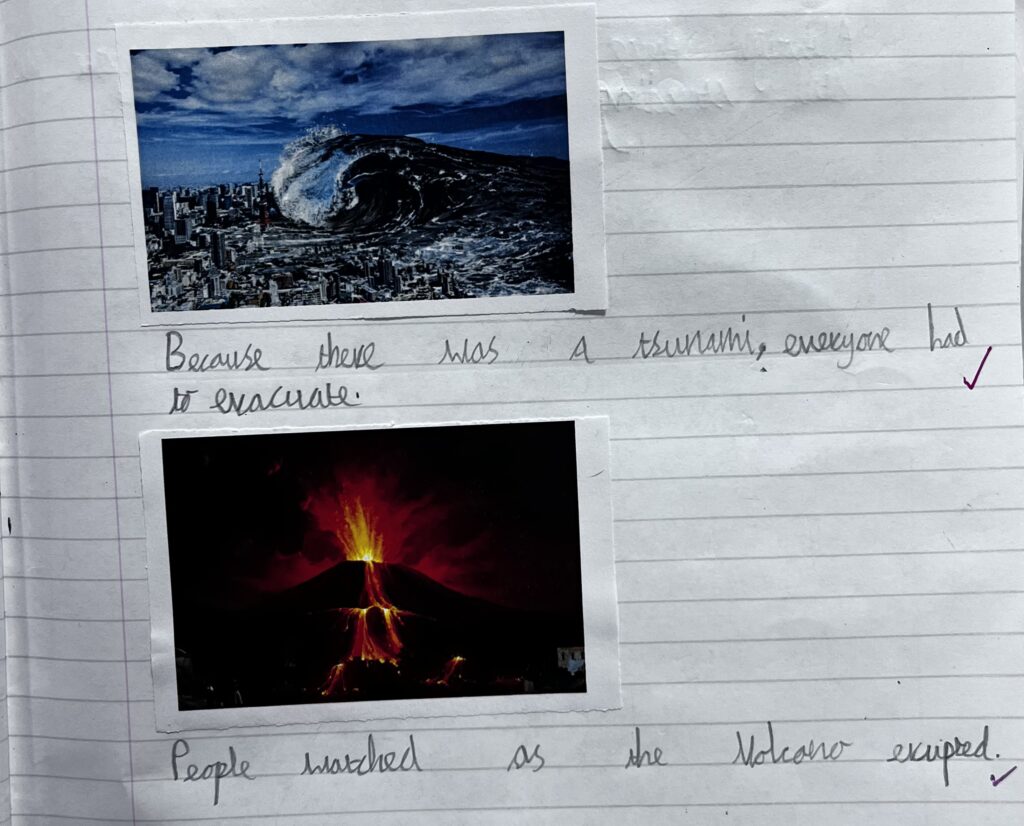
Help at home – if your child is interested in learning some alternative subordinating conjunctions, you could use this song from Grammasaurus to give them other ideas they could use in their writing https://www.youtube.com/watch?v=FK2Gyto5gTQ
Next week we will begin writing our diary entry about escaping from a volcanic eruption so there will be plenty of opportunities to show off all that we have learned about coordinating and subordinating conjunctions.
Living and Learning – I know what a drug is and that some drugs can be harmful
This week in living and learning we have been discussing how medicines and household products can help us, what the risks are of using them and how we can reduce these risks.
Year 4 were unanimous in their appreciation of medicine as something which can help you “to get better” but noted the risks:
- that if you take too much of it you may become more ill
- that you could choke on a tablet
- you might be allergic to it.
Their top tips to minimise these risks are:
- keep it in a high drawer
- if you use a syringe look at the back of the box to see how much you need
- be slow when you take it
- always do it with your grown up
- ask the doctor if you are not sure
Help at home: discuss with your child how you store and access medicine at home to keep them safe. Can you work with your child to do a ‘safety audit’ around the house to find any risks associated with medicine or household products that could be mitigated?