
Me and my community
Road safety
Today, we had a visit from Jake today from the Leeds City Council Road Safety Team. The focus of our session was, ‘helping you get ready for your new journey to secondary school.’
We began the session talking about the things that will be the same and what will be different when travelling to our high school. Jake highlighted many things that we found we are looking forward to. Such as, visiting the park/shops, travelling with friends and having a mobile phone.
However, Jake also highlighted that Year 7 children are most likely to be involved in road traffic accidents. Possible reasons for this include:
- Distractions (phones, friends)
- Rushing
- Not having the skills needed (green cross code)
- Being with friends not grown-ups
- Following the crowd
- Over-confidence
- Not using crossings
- Not being seen
- Further to travel
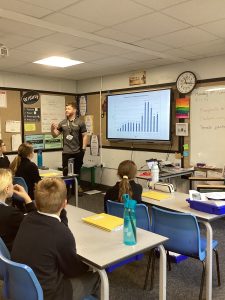
Distractions – A thing that prevents someone from concentrating on something else.
The number one distraction is the mobile phone. Jake spoke about the importance of looking up when we walk around, especially when we approach roads.
Bus passes – Some of our children will need to travel by bus when they go to high school. Jake spoke about how good under 19 photocard are. He recommended that children apply for one as it allows children to travel at discounted prices. Visit www.wymetro.com to apply.
We took part in some ‘what if’ questions. These were difficult to answer and made us think really deeply. Jake gave great advice to help us with our trips to school. Ultimately, the most important thing is that we keep ourselves safe, happy and healthy. Other key messages that came through in our sessions were that we should be organised and have a backup plan should things not go to plan.
After our session with Jake, we took time to reflect on what we had learnt:
It’s better to be safe than risking your life. Beau.
There are three types of crossing: pelican, toucan, zebra. Connor.
Even when the road is quiet, THINK, STOP, LOOK and LISTEN. Elara.
Listening to Jake has made me feel better about travelling to school next year. I feel safer. Logan.
Help at home – Talk to your child about their learning from today. What is the green cross code? Scan the QR code on the bookmark that your child will be bringing home today.
Me and my community
Royal National Institute of Blind People (RNIB)
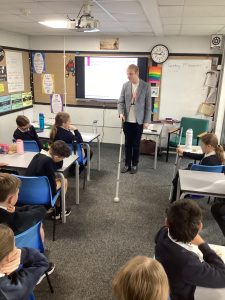
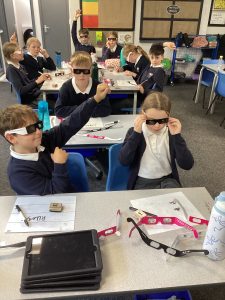
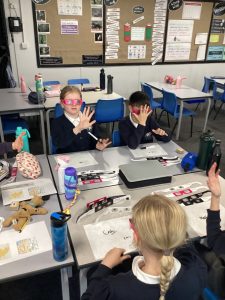
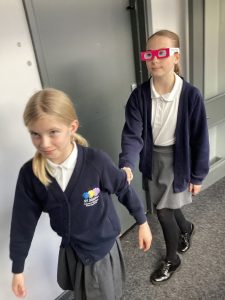
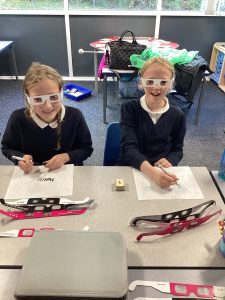
Today, we were so lucky to have a visit from Becky and Carl from the RNIB. We learnt about; how blind and partially sighted people see the world around them, how to be helpful to blind and partially sighted people and some simple ways you can make the world more friendly for everyone.
We learnt how to safely guide someone who is partially sighted and tried on various glasses to get a sense of what a partially sighted person my experience.
Carl shared with us his experience and he showed us his guiding sticks. It was fascinating talking to him and asking him questions.
I thought it was important to learn about this topic. Connor
I enjoyed learning about new things that are so important. Beau
I feel like I’d like to know more, and I have so many questions. Isla
I feel better now that I know more. I feel that I can help others more. Elara
After wearing the glasses, my head hurts and I feel tired. Emily G
I was interested to know how it feels to be blind, and I felt sad that people have to live with this condition. Emily M
Help at home – ask your child about our visitors today. What important things did they learn and what simple things can we do to help those who ae partially sighted.
Me and my community week
Protected Characteristics and British Values
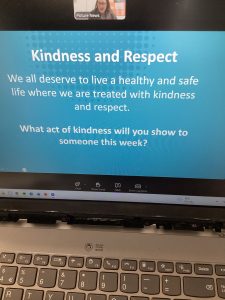
As part of me and my community week, we have an online zoom this afternoon with Claudia from Picture News.
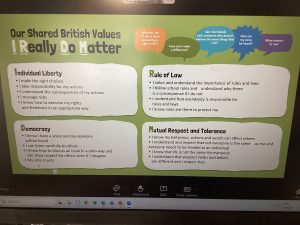
We began the session thinking about what values are and that it is ok to have different values to other people. We spoke in detail about each British Value – our children were very good at this.
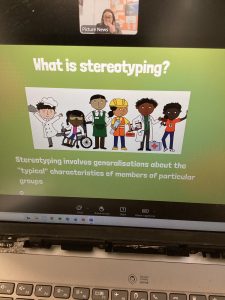
We then spoke about each Protected Characteristic and how they help to prevent discrimination and stereotyping.
Help at home – What act of kindness will you show to someone this week?
Update
What a busy week we have had in Year 6. The children have completed their first assessments in Year 6. They have done well and have shown excellent perseverance throughout. I am really pleased with where the children are, and we still have lots of amazing things to learn.
On Tuesday, we welcomed parents into our classroom. We spoke about the importance of retrieval and inference skills and looked at some RIC examples using pictures. For example:


We finished our busy week with some quality time with our Reception Buddies. We were invited down for some hot chocolate and playtime. Our Year 6 children ave been wonderful in helping the new children settle into St James’ – we are all so proud of how kind, caring and compassionate they have been.
Help at home – please ensure you are reading with your child at home on a weekly basis. Little and often really does help. They should be completing activities in their reading record books and bringing them in every Friday.
Please also allow your child time to visit Square Club Maths (QR code below). The child will really benefit for this and have shown that they really enjoy it.

Can you and your child write a retrieval, inference and choice question based on this picture:

Ancient Egypt
Building on with our topic, Ancient Egypt, Year 6 have been preparing to write a report based on this fascinating time in history. We have been learning how to take jottings and notes when researching and ensuring our notes are concise, quick and personal to us.
The children have done really well with this task although it can sometimes be tempting to just copy down what we read. This is a life skill which many of us use later on in life.
Children will be beginning their non-chronological reports next week.
In addition, one of our pupils has been away and produced some lovely work based on our Egyptian topic. Kiara has written a lovely prayer in hieroglyphics on her very own ancient scroll. Such a fantastic piece of work and displaying her enjoyment of the subject.


Help at home – If your child feels like they would like to share some learning or work they have done at home, please encourage them to bring it in and share.
RE – Creation or Science: conflicting or complementary?
To support our learning and understanding of our RE topic: Creation or Science, we have been learning about different peoples’ views. Many of these people are scientists who believe strongly in God.
To connect further with other beliefs, we invited Reverend Peat into school to answer some questions we had. We had such an informative chat and we were able to take time to reflect on our own understanding whilst connecting with Reverend Peat’s beliefs.
It was a very enlightening morning and one where we were all able to contribute. One thing that became clear is that we can’t possibly always know the answers, in this case the answer to who created the earth? By answering questions, we found that this led to further questions. This curiosity is so important in all of our learning. It was lovely to see the children engage in the discussion and be curious about our topic.
As part of our RE learning, we have an RE ‘big book’. Here are some pictures reflecting today’s learning:


Living and Learning
I respect others
This week, we’ve learnt about discrimination and our protected characteristics.
Discrimination is defined as ‘the unfair treatment of people because of who they are or because they have a certain characteristic(s)’.
We discussed examples and the impact of discrimination. During our circle time, we also discussed how this could/has impacted on our lives.
We took time to look at The Equality Act 2010. This is a set of rules that protects people from discrimination based on protected characteristics. Year 6 are very good at remembering our protected characteristics and can say why each is important. We know that these characteristics are protected by law.

Help at home – Does your child remember the protected characteristics? Why are they important?
Topic
Ancient Egypt – hieroglyphs
The children have really enjoyed learning about hieroglyphs this afternoon- learning what various symbols meant and decoding words. We even had a go a writing our own names using hieroglyphs.

I found it quite difficult because reading hieroglyphs is like learning another language. Ethan
I enjoyed it; I enjoyed writing my name. Emily M
I found it interesting how scientists worked out what each symbol meant. Isla
It was fun as it was like a hard puzzle to solve. Connor
It was interesting how each symbol can spell out words. Beau
Help at home – can you use hieroglyphs at home to write down secret words to each other? Can your child remember how to write their own name?
The Grammar Games
In Year 6 this week, our children took part in the inaugural ‘Grammar Games’. Each day, teams of children played head to head against other members of the class. We recapped our previous learning about adjectives, verbs, modal verbs and tenses.
A verb is a doing or being word. A verb tells you what is happening in a sentence.
The verb (or verb chain) is at the heart of a clause.
Without a verb, we don’t have a clause or sentence.
Sometimes we need two or more words to express the full force of the verb. This is known as a verb chain (or ‘verb phrase’).
eg We will eat.
In this sentence, ‘will’ is an auxiliary (often referred to as a helping) verb.
Verbs have tense: past, present, future
There are regular and irregular verbs.
If a verb is regular, its past tense usually ends in –ed: barked, wanted, played, answered
Verbs that don’t follow that pattern are irregular: make – made; catch – caught
Adjectives add information about the noun. Where more than one adjective is used, as part of an expanded noun phrase, they should be separated with a comma. eg the large, blue chair
A modal verb changes the possibility of another verb happening. Used to change the meaning of other verbs.
Can express meanings such as certainty, ability, or obligation.
The main modal verbs are ‘will’, ‘would’, ‘can’, ‘could’, ‘may’, ‘might’, ‘shall’, ‘should’, ‘must’ and ‘ought’.
Help at home: Discuss with your child what the difference is between a verb and a modal verb? Can they give an example of each? Can they tell you what an adjective is and provide examples?
PE
Outdoor and adventurous activities (OAA)
We have had a fantastic afternoon today, taking part in some orienteering as part of our OAA topic.
In groups, children were handed an ariel view of our school with points marked out for them to find. Children then used their map to find the orienteering points. Each point had a letter.
Once children had collected all the letters, they had to work out the missing sentence. After some excellent teamwork and a few clues, they solved the puzzle and discovered the hidden sentence.
OAA is an excellent topic that allows children to be outside whilst solving problems and working together as a team. Communication, listening and perseverance are all skills required to succeed here.


