
Year 4 – 16th September 2022
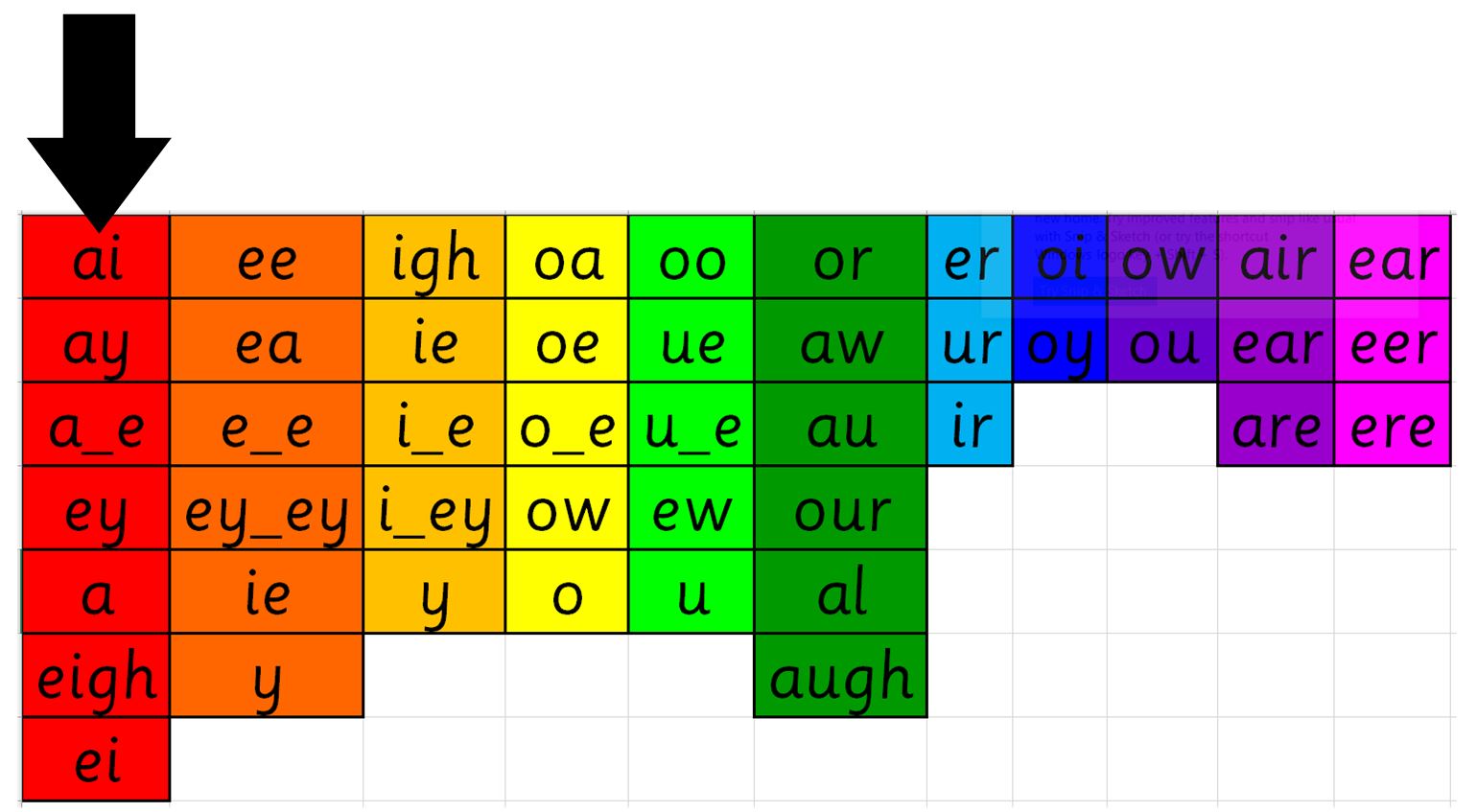
This week’s spellings all have the same sound but are written in different ways:
eight
famous
straight
strange
weight
tray
great
snake
brain
they
everyday
We call the different ways the same sound is spelled alternative graphemes. Take a look at the table below to help with this:
Science: What is a classification?
We’ve been busy biologists in our science lesson this week! 😁
We used Venn diagrams to help sort and classify animals using different criterion. Murielle, Aubree and Lilly thought of classifying animals according to their number of legs or if the animal had fur. Jacob, Evie and Liam classified animals by scales or if the animal had a tail.
Check out this short animation. Before we classified animals, we used biscuits to support our understanding of classification. See if your child can chat about the time we classified biscuits..! Here’s a little hint for them…

Year 3 16th September 2022
Next week, we will continue to learn words that contain the ‘ai’ sound. The children will be tested on the words below next Friday:
eight
favourite
tray
great
snake
brain
they
everyday
8 Rs for learning!
This week, in our living and learning lesson we thought all about the importance of each of the 8Rs for learning. These help us to achieve our very best when we are at school.
ready
responsive
responsible
resilient
risk-taking
remembering
reflecting
resourceful
We discussed what these mean to us and how they can make us better learners. The children then shared all of their ideas. We have displayed them in our classroom to help us remember how we can achieve each of the 8Rs for learning.


Challenges
In our classroom, we have lots of challenges linked to our learning. We have a Maths, Reading, Writing, Phonics, Science and Topic challenge. Each child has a challenge chart and all week during choosing time we work hard to complete the challenges and tick them off on our challenge chart. Every Friday we spend some time as a class talking about the challenges. We had lots of certificates today for lots of super learning! Well done, keep it up Year 1!


This week’s message (Friday 16 September 2022)
This week’s message comes from Mr Wilks, who’s our Science and Foundation Subjects Leader. In this message, Mr Wilks introduces your child’s current topic…
What do we mean by topics?
Topics are the vehicle for delivering much of the learning in the foundation subjects (eg Art, History, Geography). Each half-termly topic has a driving subject – the main focus for teaching pupils knowledge and skills.
There are opportunities for enrichment through other subjects. For example, learning in an art topic may be enriched by geography learning about where an artist was born and lived.
Read more about the intent, implementation and impact of our topics.
What is this half-term’s topic?
This half-term, we’re historians. We’ll develop our understanding of the past, both in Britain and the wider world.
Each phase has age-related specific knowledge, skills and vocabulary: see pages 27 and 28 of our Curriculum Statement.
Each phase also has key historical concepts which will feature within most lessons. These historical concepts are themes that are revisited, strengthened and deepened during your child’s journey through the history curriculum. See page 24 of the Curriculum Statement.
Years 1 and 2
In this topic, children learn about a significant British historical event: The Great Fire of London.
Children will learn about life at the time of the Great Fire of London. They’ll learn where the fire started and how it spread so quickly and the innovative ways that it was extinguished. Importantly, they’ll learn about the different sources of evidence that have helped us answer these questions, including Samuel Pepys’ diary. Finally, they’ll learn about the significant changes that occurred as a result of the fire, such as legal changes about the way houses were built and the beginning of a fire service in London.
The key concept that children will learn about in this history topic is innovation.
Years 3 and 4
In this topic, children learn about Ancient Greece.
Children begin by sequencing periods of British history and seeing where the ‘golden-age’ of the Ancient Greek civilisation sits alongside. They’ll then learn about two contrasting city states: Athens and Sparta. Children will learn about the type of government these states had and what the lives of the people living there were like. They’ll then debate which city state was the best. Next, they’ll focus in on the influence that Athens has had on the world: democracy, mathematics, philosophy, literature, culture… Finally, they’ll learn about how the civilisation ended.
The key concepts for this topic are civilisation, government and innovation.
Years 5 and 6
In this topic, children learn about Stone Age to Iron Age Britain and contrast it with Ancient Egypt.
They begin by looking at and creating timelines which sequence the periods of British history and also placing Ancient Egypt on this timeline. They’ll learn about the advances and innovations that occurred during the New Stone Age, Bronze Age and Iron Age. They’ll learn about and understand that the sources of evidence we have are limited to archaeological evidence. They’ll then learn about the Ancient Egyptian civilisation and contrast this with what was happening in Britain at the same time – it’s a stark contrast!
The key concepts for this topic are innovation and civilisation.
How can you help?
Talk to your child about what they have been learning in class. The class news pages are a good place to go to find out more about what the children are doing.
Find some books from the library which match what your child is learning. I’m sure there’ll be plenty of books about the history your child will be learning about.
Watch television shows about history. Horrible Histories is great (regardless of your age!).
The BBC Bitesize history webpages have been revamped this summer and have lots of information about the history being covered this half-term.
If it’s a rainy weekend and you’re looking for something to do, why not spend a morning or afternoon in a museum? A visit to Leeds City Museum (next to Millennium Square) would be great for all children but especially for Y3,4 and Y5,6 children as it has some Ancient Greek and Ancient Egyptian exhibits, including Nesyamum, the 3,000 year old Leeds mummy!
London’s a bit far for a rainy weekend but the Fire of London website is great and will support and deepen children’s learning.
16 September 2022
This weeks spellings are the same as last weeks. Please continue to practice them. Why not try the look, say, cover, write and check method.
Y1: are ask be by come
Y2: are ask be by come do for friend full go

16.09.22 Spellings
This week, we’ve been learning about words that contain a double consonant following a short vowel sound. Learn the following words for a test on Friday 23rd September:
accommodate
accompany
aggressive
apparent
appreciate
attached
correspond
embarrass
exaggerate
immediately
If you are finding these spellings difficult to practise at home, here’s an alternative list that follows the same spelling rules:
apple
cliff
glass
spell
shell
Note: There will be a spelling test for each set of words, so don’t worry about having to learn both!
Reading Records
Today, the children will be bringing home their new reading records. Please write a comment about your child’s reading in the parent comments section and bring the reading record back to school every Wednesday. We will send the reading record back home again on a Friday. Your child’s new e-book will be issued on a Friday.
16 September 2022
There’s a social theme to this week’s Talk Time.
In our school, we have 3 school rules:
- We keep our hands, feet and objects to ourselves.
- We follow instructions.
- We respect everyone and everything.
Is it important to have rules to follow in and outside of school? Is there a rule that we’re missing?
This week’s R2s (‘remember tos’) will help you to provide a balanced argument before you reach a conclusion:
- What are the reasons for having rules to follow (the pros)?
- What are the reasons against having rules to follow (the cons)?
- Reach a decision. Is it valuable to have rules to follow?
- One list may have more points than the other.
- Some points have a greater importance than others.
One way to approach this Talk Time is to have a debate with people in your household. This will not only help you generate ideas but also practise a range of oracy skills. Last year, one of the oracy focuses was building on the views of others and reasoning. When someone raises a point that you’re in agreement with, use one of the following phrases to start your response:
- I agree with you because…
- That’s a good point. I also think that…
- Furthermore, I’ll add that…
On the other hand, you may disagree with a point made by a family member. When that’s the case, it can be hard not to interrupt them. Another oracy focus from last year was turn-taking. To be respectful of others’ opinions, wait until a person has finished speaking and then respond using one of these sentence starters or one of your own:
- I hear what you’re saying but…
- That’s a good point. However…
- I take your point but…