
Autumn 1: Week 7
This week, we’ve really enjoyed immersing ourselves in the story of Supertato! The Evil Pea escaped from the freezer again, but luckily, we’ve been busy creating our own traps in the workshop area to help protect our classroom. We’ve also written messages to the Evil Pea and Supertato and made our own observational drawings of a vegetable, looking closely at the markings and different colours on each piece.

We’ll be continuing our Supertato adventures next week.
Phonics
We’re so proud to share that’ve we’ve finished learning all of the Phase 2 phonemes for this half-term! Next week, we’ll focus on practising our blending skills and recapping all the phonemes. Well done, everyone!
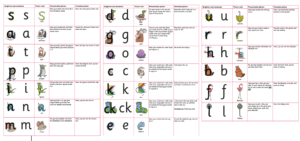 Help at home: Please recap all sounds covered so far. Practise saying the pure sounds and writing the corresponding graphemes.
Autumn 1: Week 6
This week, we’ve been using our story map to retell the story We’re Going on a Bear Hunt. We made sure we used lots of story language from the book and added some actions.
Phonics
This week our phonemes were ck, e, u, r and the tricky word I. Next week, we’ll be learning the final four phonemes for this half-term: h, b, f and l.
Help at home: Please use the ‘Learning at home’ sheet to regularly practise all of the letters and tricky words.
Harvest Festival
On Wednesday we joined the whole school celebrate Harvest Festival in church. We walked with our buddies and enjoyed chatting to them as we walked, when we got to church we placed our Harvest offerings on the alter and enjoyed all the songs.
Finally, a few photos from our independent learning this week.

Next week our focus story will be Supertato by Sue Hendra and Paul Linnet.

Have a lovely weekend,
Mrs Kendrew, Mrs Linton, Mrs Spearman and Miss Dean.
RE – Creation or Science: conflicting or complementary?
To support our learning and understanding of our RE topic: Creation or Science, we have been learning about different peoples’ views. Many of these people are scientists who believe strongly in God.
To connect further with other beliefs, we invited Reverend Peat into school to answer some questions we had. We had such an informative chat and we were able to take time to reflect on our own understanding whilst connecting with Reverend Peat’s beliefs.
It was a very enlightening morning and one where we were all able to contribute. One thing that became clear is that we can’t possibly always know the answers, in this case the answer to who created the earth? By answering questions, we found that this led to further questions. This curiosity is so important in all of our learning. It was lovely to see the children engage in the discussion and be curious about our topic.
As part of our RE learning, we have an RE ‘big book’. Here are some pictures reflecting today’s learning:


Autumn 1: Week 3
We’ve had a busy week in Reception! The children have really coped well with all of our carpet times. They’ve shown great listening skills and have been ready to learn during all of our carpet sessions.
Phonics
This week, we have learnt our first four phonemes (the sounds a letter makes) s,a,t and p.
During our phonics learning, we listened carefully to the initial sound in a word and sorted objects by the sounds they begin with.
Help at home: Look out for a ‘learn at home’ sheet which recaps the phonics learning from the week. Please look at this with your child and complete the activities.
Poetry Basket
Each week we will be learning a new poem. We will recite this poem each day. By saying the poem out loud, we can focus on the sounds and rhythm of each word or line. We talk to the children about how this can help us become better readers. This week we introduced our first poem called Chop Chop.
Chop, Chop, Choppity Chop.
Cut off the bottom and cut off the top.
What there is left, we put in the pot.
Chop, Chop, Choppity Chop.
Help at home– Ask your child to recite the poem to you, can they remember the action as they perform it to you?
Reminders
Don’t forget to attend out Welcome to Reception meeting at 6pm next Wednesday. This will give you some basic ‘need to knows’ about life in Reception. There’ll also be an opportunity to ask any questions.
Please continue to send in family photos so we can share them in class and add them to our class display. We’re also filling up our autumn tray, please keep looking out for signs of autumn when you are out and about and adding them to the tray. Thank you.
Have a happy and healthy weekend.
Mrs Kendrew, Mrs Linton, Mrs Spearman and Miss Dean
Welcome to Reception
We’ve been busy over the summer holidays washing all the teddies and toys so we’re ready for when you start ‘big school!’
Your classroom is all ready and set up and we’re looking forward to lots of learning, making new friends and having fun!


We’re so looking forward to the year ahead, getting to know you and your children.
See you all soon,
Mrs. Kendrew, Mrs. Linton, Mrs. Spearman and Miss. Dean
Tidy week 2
This was our second week using the book Tidy by Emily Gravett. This week we practised orally retelling the story using actions to help us remember.

Art
This half-term, our featured artist is Alexander Calder. Calder was most well known for his sculptures and mobiles. We explored photographs of his artwork, discussing the different shapes, colours and how his creations made us feel. Inspired by Calder’s moving mobiles, we designed and made our own using plastic bottles, paint and glitter. They are now hanging from the classroom ceiling for the wind to catch and make them move.
Sports day reminder
Sports Day is on Tuesday at 9.30am. Please ensure your child comes to school wearing PE kit. They should also wear a t-shirt in their team colour. As the weather is expected to be warm, please make sure your child brings a named sun hat and has sun cream applied before they come to school.
Meet your new teacher
On Wednesday morning, the Reception children will spend some time getting to know their new teacher and exploring their new classroom. This is an exciting part of the transition process and helps the children feel more confident and familiar with their new learning environment.
Thank you to all the parents and carers who joined the transition Zoom meeting. We hope you found the session useful. As always, if you have any questions, comments or concerns, please don’t hesitate to speak to me.
Summer 2: Seaside and Cities
Welcome to our final half term in Reception our theme is Seaside and Cities and our focus books this half term are


Have a fantastic half term everyone and enjoy the sunshine but be safe. Drink lots of water and don’t forget to wear some sun cream.
A visit from d:side
On Friday we had a special visit from d:side who talked to us about different feelings and what we could to to help us when we have these feelings. We had some fantastic responses and it was clear to see that our Feelings First sessions are a success.

“He is feeling cross and angry, when I am angry I rip up paper until I feel calm again.”
“She is sad, she needs to tell her mummy or the teacher. They can help her feel better.”
We also talked about being healthy and did some exercises in class. Dave was very impressed with how well we listened and answered each question.
Well done Reception, you showed our visitor how fantastic you are.
Summer 1
This half term will be learning about bugs and will be going on lots of bug hunts. We will be learning about the life cycle of a butterfly and will hopefully set some free! We will be using some hand drills to build a bug hotel for our outdoor area.
We are also hoping to develop our outdoor space a bit more so if anyone has any compost, plant pots, tree stumps or plants we would would really appreciate them.
Reminders and Notices
Forest School- It is our turn to go to Forest School after the holidays. Please send your child to school in their PE kits on Friday with waterproofs and wellies in a labelled plastic bag.
Jack and the Beanstalk
This week we’ve continued our learning using the traditional story Jack and the Beanstalk.

We’ve learnt to retell the story using our class story map and a few actions to help. Our prosody has really improved as we became more confident with the story.
Maths
In maths we’ve been doubling, we’ve used the stem sentence 2 is made of 1 and 1, double 1 is 2. Doubling numbers up to 5. We’ve also had a go at doubling the leaves on a beanstalk.

Poetry Picnic
Each week we learn a new poem and recite it every day. By saying the poem out loud, we can focus on the sounds and rhythm of each word or line. We talk about how this can help us become better readers. This week’s poem is called Hungry Birdies.
Hungry Birdies
I have built a little nest,
look inside, look inside.
Hungry birdies with their beaks,
open wide, open wide.
And the little birdies grow,
day by day by day.
‘Till they spread their wings and fly,
far away, far away.
We talk about how a poem sometimes has rhyming words and sometimes doesn’t. Can your child tell you the rhyming words in this week’s poem? We also talk about how a poem can have a fast rhythm or a slow rhythm.