
Maths – Division by sharing
In maths, we’ve been learning to divide.

This week, we’ve used the idea of sharing to help us to divide. When dividing by sharing equally, you’re calculating how much (or how many) each person (group) gets.
When dividing by sharing, it’s important to ask some key questions:
- How many are there altogether?
- How many groups are there?
We can use these questions to write our division equation.

The children really impressed me with their learning. We practised division by sharing using counters, saying these stem sentences to show our understanding:


Help at home by practising some division by sharing. We love this game.
Beanstalks
It is with great excitement (and some relief) that our beans are growing! They seem to be shooting up superfast now and the children are so eager to check on their progress each day.


They will be coming home with the children for the Easter holidays. The pots are bio degradable so can be planted straight into the ground. They may need a cane to support them as they grow, the children have high hopes of visiting the giant and bringing back some golden eggs.
Number 3!
We have loved learning all about the number 3 and the parts that make 3. See if they can tell you them at home.


Building Finger Strength
We always have a challenge out that helps to build our finger strength and fine motor skills. This week we had loom bands and a board. There are so many activities like this you can do at home.


Next week we’ll be looking at positional language in our maths. Using words such as “above,” “below,” “next to,” “in front of,” and “behind.”
Help at Home: Can you give your child an instruction including some positional language? For example, “put the teddy in front of the cushion.” Then let them be the teacher and give you the instructions.
David and Goliath
Year 3 have been learning about David and Goliath – a well known Bible story. Here’s a quick synopsis of the story:
Goliath is big, very big! He had a big voice, too.
“I dare any of you to battle me!” he bellowed. “Win, and we will be your slaves. Lose, and you must work for us.”
David was smaller than Goliath, and this made him a little angry. David went to see the king. “I want to battle Goliath”, he said. The king did not hold much faith in David as he was small, and Goliath was tremendously big. The king offered David his armour, but David refused as it wouldn’t fit and was too heavy. Instead, he gathered some small stones and a sling and set on his way.
David lured Goliath to a valley and struck him on the head with a stone from his sling. Goliath fell with a big thud to the ground.
David later became king – one of the greatest kings God’s people ever had.
We thought about this story and how it may link to our school vision:
St James is a happy and healthy place to achieve and believe.
Here’s what the children came up with:
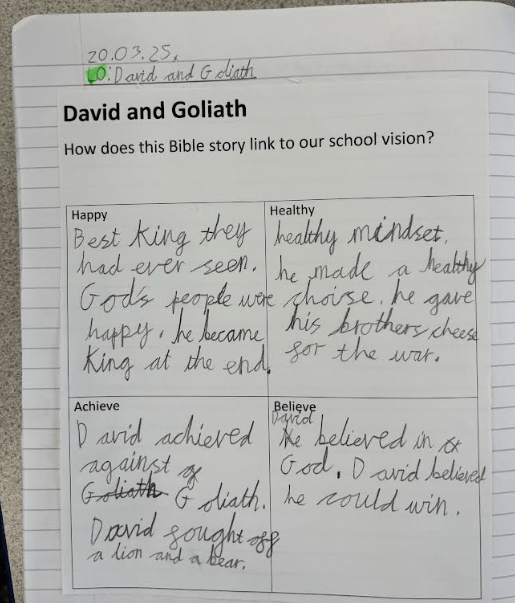
We then discussed how the story may link to our Christian Values, and how we may use these messages in our daily lives to help us grow.

Help at home:
Our 6 Christian values are: honesty, perseverance, peace, compassion, forgiveness and courage. Talk with your child about how they may use these values in and out of school. Can they give an example of one used this week?
Circle Time
During circle time, we reflected on our personal experiences of perseverance—those moments when we kept going even when things felt difficult. We thought about times when we were learning something new and how it made us feel. As we shared our experiences with our peers, we realised that many of us had similar emotions.
- “I felt shy and nervous when I had to perform on stage but afterward, I was really proud of myself because I did it!”
- “Moving up to Stage 5 in swimming was scary because the big pool was so deep. But I kept trying and in the end, I felt really happy with myself.”
- “At the park, I wanted to go down the big slide but I needed some help from my grown-up. I felt excited but also a little nervous.”
- “When I first started learning to read in Reception I felt frustrated but I kept going and now I love reading!”
We then explored our Christian values and discussed how the emotions we experience when learning something new link to perseverance and courage.
Help at home: Talk about a time when you learned something new. How did it make you feel?
British Library Workshop
This week, we were lucky to be visited by the British Library for a day of creativity. We used spoken language, visual literacy and reading comprehension to creatively explore and understand the experiences of refugees as they settle in a new country. Inspired by Sarah Garland’s heartwarming graphic novel, Azzi in Between.
The children thoroughly enjoyed learning about experiences refugees go through, creating dramas to explore characterisation and performing to their peers.
If you would like to borrow the book, please ask – we have a copy in our reading corner.


World Book Day
Last week, we celebrated World Book Day! The children in Years 3 and 4 really enjoyed the day, full of exciting reading lessons and activities. The highlight of the day was the reading café, organised by some of our Year 5/6 pupils. The children had an opportunity to explore books and reading activities with one other, drink delicious hot chocolate and enjoy the lovely sunshine!


Spring and Counting Skills
Signs of Spring
We’ve spotted some signs of spring outside at forest school. We’ve spotted buds, shoots, flowers and listened to birds singing.


I’ve been so impressed with the children’s counting skills this week. We’ve all had a go at counting objects and saying the amount.


Help at home: Practise counting different objects during play and in everyday life. Make sure children say one number for each item; it often helps to move each item as you count or line them up so that children only count each object once.
Can they remember how many they had in total without counting again?
1,2,3 there are 3
Outside we’ve been making race cars with the large construction and climbing trees in Forrest School.


Next week we’ll be looking at healthy eating and where food comes from. Painting vegetables, tasting vegetables and exploring different herbs.
The Hundred Decker Bus
It’s been another busy week in Reception this week. We have been looking at the focus book The Hundred Decker Bus by Mike Smith. The children loved the journey the bus took.

Our word of the week was Countryside- land that is away from big towns and cities. We’ve also used Google Earth to find school and some of our houses. We had so much fun, we will continue looking for more places next week.
Maths
This week in our Maths we have been comparing and considering where numbers to 8 are in relation to each other. We have used the vocabulary ‘more than, less than and equal to’ to describe the relationship between them. The children have enjoyed making the stair pattern to help them to describe each number.

“7 is more than 6”
“3 is less than 4”
“5 is more than 4 but less than 6”
Phonics
Spring 2 week 3 has been a review of phase 3 sounds, reading words with two or more digraphs (2 letters that make 1 sound). We review tricky words (a word you can’t sound out – you just have to know it) daily.
Tricky words can be just that-tricky! Tricky Word Bingo is still a huge hit in class and the prizes are becoming incredible, this week we have been playing for a trip on a cruise ship and a golden helicopter!
Poetry Picnic
Each week we learn a new poem and recite this poem every day. By saying the poem out loud, we can focus on the sounds and rhythm of each word or line. We talk to children about how this can help us become better readers. This week’s poem is the traditional nursery rhyme Pat a Cake, Pat a Cake. We turned this in to a clapping song and the children enjoyed singing it with a partner.
We talk about how a poem sometimes has rhyming words and sometimes doesn’t. Can your child tell you the rhyming words in this week’s poem? We also talk about how a poem can have a fast rhythm or a slow rhythm.
Reminders and Dates
‘Number’ Stay and learn – Tuesday 18 March 2:20-3:00pm
Our Stay and Learn sessions are a chance to find out more about your child’s journey through Reception. You can observe some teaching and learning, and pick up some tips to support your child at home. This session is all about Number.
Please send your child into school with an empty shoebox next week. The children will be creating their very own deck, based on their designs.
Have a happy and healthy week and thank you as always for your support.
Mrs. Kendrew, Mrs. Rippon, Mrs. Small and Mr. Smith
Chess Club
Chess Club is up and running…


