
Year 3 Drama Workshop Fun!
Year 3 had a very exciting morning yesterday as we welcomed some high school students for a wonderful drama workshop!
The children watched the high school students bravely perform in front of an audience, showing confidence, creativity and courage. They then had the opportunity to get involved themselves, taking part in a variety of fun and interactive drama games.

There were lots of smiles, laughter and enthusiasm as the children explored drama, expressed themselves and built their confidence. It was lovely to see everyone getting involved and having such a fantastic time!
A huge thank you to the high school students for inspiring our Year 3 learners and making the morning so memorable.
Congratulations to our Year 2 Junior Leadership Team (JLT) candidates!

I am incredibly proud of how hard the students worked on creating and delivering speeches to convince their classmates to elect them. Every single child did an amazing job reflecting on the qualities of a great leader and pouring those ideas into their presentations. We are so lucky to have a class full of such enthusiastic, willing future leaders. Congratulations to George H. and Darcey, our newly elected Year 2 JLT members!
Update
What a busy week we have had in Year 6. The children have completed their first assessments in Year 6. They have done well and have shown excellent perseverance throughout. I am really pleased with where the children are, and we still have lots of amazing things to learn.
On Tuesday, we welcomed parents into our classroom. We spoke about the importance of retrieval and inference skills and looked at some RIC examples using pictures. For example:


We finished our busy week with some quality time with our Reception Buddies. We were invited down for some hot chocolate and playtime. Our Year 6 children ave been wonderful in helping the new children settle into St James’ – we are all so proud of how kind, caring and compassionate they have been.
Help at home – please ensure you are reading with your child at home on a weekly basis. Little and often really does help. They should be completing activities in their reading record books and bringing them in every Friday.
Please also allow your child time to visit Square Club Maths (QR code below). The child will really benefit for this and have shown that they really enjoy it.

Can you and your child write a retrieval, inference and choice question based on this picture:

Philosophy Friday: Sprituality
Today’s philosophical statement:
Always. Sometimes. Never.
Being spiritual links to religion.
The children were given time to think deeply about this statement and whether they believe it is always, sometimes or never true. During these sessions, children are prompted to use a variety of sentence starters to encourage meaningful discussion (shown below).

The responses from pupils were articulate and well-thought. They showed good voice projection, too. Here are some snippets of our discussion:
Sometimes
Feeling spiritual can be as simple as watching leaves fall from a tree, and that’s not a religious thing. However, it could be linked to religion to some people if that’s what they choose to connect with. – Jack F
Sometimes
Because having a connection to the world is great. – Elijah
Sometimes
You don’t need to be religious to be spiritual. Spirituality can link to God but it can also link to nature, yourself, our environment and our friends and family. – Hattie
JLT elections
I’m so proud of Year 4!
Today we were blown away by lots of persuasive JLT speeches! The children used great courage and empathy to present the reasons why their peers should vote for them to be a member of the JLT. It must have been a very hard decision for voters given the quality of the candidates!

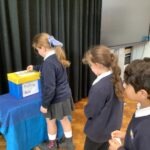
We really enjoyed reflecting on how our JLT election has its roots in democracy which was created in Athens during the Golden Age of Ancient Greece.
The new JLT members will be announced in Collective Worship tomorrow and Mr Nash is excited to hear all of their suggestions.
Autumn 1

Spellings to be tested Friday 16th October
This week’s spelling rule is:
Drop the y for an i
When a word ends in y, we often change the y to an i before adding a suffix.
Remember:
y → i before adding the suffix
Examples:
carry → carried
worry → worried
copy → copied
Can you spot where the y has changed to an i?
Spellings to practice that use this rule:
- happily
- happier
- happiest
- easily
- easier
- carried
- worried
- copied
- tried
- cried
Help at home: Encourage your child to say each word aloud, identify the root word and explain how the spelling changed when the suffix was added. Challenge them to think of other words that follow the same spelling rule.
Living and Learning: Understanding protected characteristics
This week, Year 3 explored the statement: “I understand some characteristics are protected by law.”
We learned about identity, protected characteristics and why it is important to show respect towards ourselves and others. The children discovered that there are nine protected characteristics protected by the Equality Act 2010.

We discussed the meaning of discrimination, which is when someone is treated unfairly because of their identity. The children thought about why discrimination is wrong and why it is important that everyone is treated with kindness, fairness and respect.
We also discussed how we can be positive peer educators and demonstrate respect towards people whose identities, experiences or characteristics may be different from our own.
As a class, we created our own commitment to respecting everyone’s unique identities:
“Treat everyone and everything the same way we would like to be treated.”
The children also completed personal reflections about how they can show respect towards others and what they should do if they see or hear someone being treated unfairly.
Help at home: Ask your child to explain what they learned about protected characteristics and discrimination. Talk about why it is important to treat everyone with kindness, fairness and respect and encourage your child to think about how they can help others feel included, valued and welcomed.
Living and learning – protected characteristics
This week, Year 4 have continued learning about protected characteristics and why they are so important.
Protected characteristics are parts of a person’s identity such as their age, disability, race, religion or sex that are protected by law.
We discovered that the law helps protect people from being treated unfairly because of who they are. We discussed examples of when people might need to be protected and how everyone deserves to be treated with compassion and respect. We thought about what we could do if we felt like we were being treated unfairly or if we saw someone else being treated unfairly.
Help at home: If you would like to discuss protected characteristics with your child at home, this website would be a great way to facilitate discussions and further reflections https://www.bbc.co.uk/bitesize/articles/z8yjdp3#zqjgr2p
Harvest Festival
Year 2 visited church this week to celebrate Harvest Festival. The children proudly shared a harvest poem with actions that they had been practising in class. During the service, they learnt about the importance of celebrating harvest, giving thanks for what we have and remembering those who are less fortunate. The children also brought in food donations to support the food banks in Wetherby and Seacroft, showing kindness and generosity towards those in our local community. We are very proud of their thoughtful contributions!
