
Our learning journey this week
We have been extremely busy learners this week as the children continue to adapt well to life as key stage 2 pupils.
writing
We are well on the way with our first piece of writing and we’ve managed to complete paragraph one of our Athens recount. The children have made sure to include our R2s:
- adverbs
- prepositions
- past tense
Here are some examples of pupil paragraphs:

Poppy

Adam

Carter

Sophie

Elijah
Help at home:
Discuss and practise adverbs and prepositions as we have learnt them in class. If you’re unsure, use the guide below. Perhaps your child could write sentences with an adverb and a preposition?
Adverb = adds information about a verb
I walked fiercely through the town.
Preposition = tells you where something is in relation to something else.
The soldier hid behind the market stall.
Wonderful writing
In Year 5/6 this week, we have been writing a recount about discovering a secret parcel linked to our class novel, ‘Secrets of a Sun King.’

The quality of writing has blown me away and the children have really enjoyed adding tension to their work. They have all been keen to share some of their writing and have chosen sentences/extracts to share:
This was the opportunity as everyone was asleep. I was ready to open it and as soon as I did, I became unconscious – James
As dark as an abyss, I had to grab the flashlight from the truck. Wrapped in dazzling vermillion thread – Aubree
The goosebumps on my body rose as I got to the stairs. The adrenaline levels, in my body, shot up – Evie
Shivering, I felt scared. I was not sure if it was midnight or not – Madeleine
It was locked in a safe, but it only took a kick to open it. The parcel was wrapped in gold with a red ribbon – Liam
Without hesitation, I pushed open my bedroom door trying not to make a sound. I edged towards the bathroom. My heart sank, knowing full-well the only door that could make the ear-twitching sound was my grandparents – Noah
I observed the mystifying parcel wrapped in a beautiful white satin bow. My hands were juddering – Kamile
She entered with an inconspicuous lunchbox. It was in my grasp – Lilly C
I suddenly woke up, now was my chance to get the parcel. I was in trouble, but I couldn’t help myself – Honey
Returning the parcel, I had the biggest smile on my face –Leo S
Something deep inside me told me I knew what it was. It was antique with golden swirls in the corner – Valerie
The box was wrapped in camo and smeared with mud. It was very inconspicuous. I stared at it for a second, it seemed to be burnt slightly – Christian
I was almost certain it was time to go. I opened the parcel to reveal… – Freddie
The full moon was out, it was like a torch shining on me. Inside was a perfectly round crystal ball, it has purple smoke inside – Lily W
I walked as quiet as a mouse, trying hard to not make a sound – Charlina
I cut my hand in the process. Now I was scared – Willow
Without hesitation, I stealthily dashed passed the trees – Umar
We all hurried like hungry mice. At lunch, my friends and I crept cautiously like three spies into the Year 5/6 classroom – Murielle
Stealthily, I tip toed out of my room – Tommy
Slowly, I edged towards the door. The parcel was grey with a beautiful lilac silk bow – Summer
Just shy of dawn… As shy as a fox… Now I start my descent – Ralph
Help at home – Ask your child about some of the various ways they can begin a sentence. Can they write a short passage recounting something they have done? How can they keep the reader intrigued?
Reading
Just a reminder to please encourage your child to read at home.
10 minutes, three times a week would really help your child’s fluency and understanding. Once they have read, please sign reading records to say that they have been heard. Child should also complete an activity per week in their reading records.
Any queries, please don’t hesitate to ask.
Thank you for your support, Mr Kilner.
Living and Learning: Manners
Manners are words and actions that we can do to help us be kind and respectful to others. Good manners help us to get on well with others.
We thought about examples of good manners and thought about when we had used our good manners.
I said thank you when I got my lunch.
I held the door open for a teacher.
I said sorry when I accidentally stood on my friends foot.
I said excuse me to go past someone.
Help at home: reinforce this message about using good manners at home as well as at school. Encourage your child to greet the adults on the gate as they arrive at school.
Also, have a go at this manners quiz to check your child’s understanding.
Topic
Our Topic this half term is History and we are learning about The Great Fire of London (GFoL). The children are enjoying learning some key facts about why the GFoL was so ‘great’.
We’ve been enjoying singing along to Londons Burning and reading the Poem The Great Fire of London by Paul Perro (This is a YouTube link. Top tip for watching YouTube with your child: go to the settings cog along the play bar and turn off autoplay – this avoids an inappropriate clip coming up automatically, and helps to discourage your child from passively watching clip after clip).
We’ve also read the book, Vlad and the Great Fire of London, (This is a YouTube link. Top tip for watching YouTube with your child: go to the settings cog along the play bar and turn off autoplay – this avoids an inappropriate clip coming up automatically, and helps to discourage your child from passively watching clip after clip) to stimulate our learning.
Help at home: Ask your child to tell you some of the facts they have learnt so far.
- When was the GFoL? (Sunday 02 September 1666)
- What was the cause of the fire? (A spark from an oven ignited the fire)
- Where did the fire start? (in a bakery on Pudding Lane)
- What did they use to try to put the fire out? (fire hooks, buckets of water and water squirters)
- Can they name the important historical figure who wrote a diary about the GFoL? (Samuel Pepys)
- Why did the fire spread so quickly? (because the houses were made from wood and they were built close together).
Maths – Flexible Partitioning
In our ongoing maths quest to master place value, we’ve been partitioning flexibly…
Sounds fancy, but what does it mean?
The children have been learning the component parts of numbers and the value of their digits. For example:
75 is made up of 7 tens and 5 ones.
The value of the 7 is 70.
The value of the 5 is 5.
70 plus 5 is equal to 75
70 + 5 = 75
We’ve been exploring the different ways that numbers can be partitioned. For example:
60 + 15 = 75
54 + 21 = 75
23 + 52 = 75


Help at home by exploring flexible partitioning. Use these stem sentences to help secure understanding of number.
The number is ___.
___ is made up of __ tens and __ ones.
The value of the __ is __.
The value of the __ is __.
How else can the number be partitioned?
Writing in Year 4 this week
This week, we have been developing our knowledge and skills in using certain types of words to make our writing more exciting. Can you spot them on our working wall?


Adverbs
We started the week applying our knowledge of adverbs. We wrote sentences about a soldier from Ancient Greece who returned to Athens from a war.


Using an adverb makes our writing more exciting because it gives us more information about the verb. Some of us wanted an extra challenge so we used the adverb at the start of the sentence and followed the adverb with a comma.
Prepositions
Having mastered adverbs, we moved on to identifying prepositions.


For a challenge, we tried some SATs style questions to show off how confident we felt about finding prepositions in sentences.
Being able to confidently identify prepositions set us up to compose our own sentences using prepositions. For those of us wanting a further challenge, we included adverbs to help the reader picture the scene.

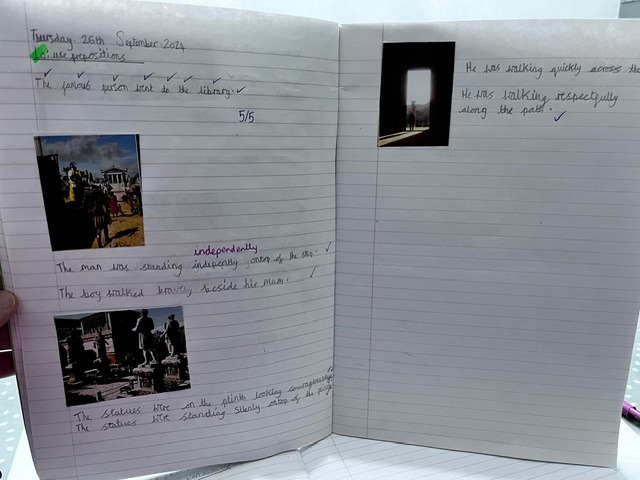

Next week, we will be planning and drafting our recount. I can’t wait to see how these sentences develop into a descriptive recount! Watch this space for copies of the finished pieces!
Help at home
Play a game of adverb charades – Mime performing an action, such as skipping, in the style of an adverb. The rest of the players must then try to guess the adverb.
Example – while skipping with a big smile and swinging my arms, I could be miming the adverb ‘excitedly’.
Bonus points for any unusual adverbs!
The Everywhere Bear
This week we have had great fun with our focus book The Everywhere Bear by Julia Donaldson and Rebecca Cobb.

In the story the Everywhere Bear goes on lots of adventures with the children and a huge journey when he gets lost! We added actions to help us to remember the ten different place he went, this helped us to remember and say them all. Great work reception!

Our word of the week has been journey the children have really enjoyed using this during their learning. We also created maps to show some of the journey’s we go on.
“On my journey to school I go past the Bob shop.”
“I found a conker on my journey today.”
Poetry Picnic
This week our poem was Breezy Weather
Breezy weather. Freezy weather.
When the leaves fall, we all fall together.
Breezy weather. Freezy weather.
When the wind blows, we huddle together.
The classroom Challenges this week have been
- to write a message to the Everywhere Bear.
- to cut along the lines.
- to join two materials together.
- to make a map of a journey.
- To use the investigation station to explore the garden.
- to use the images to say what you can see and how you can see it.
Phonics
This week, we have learnt the phonemes (the sounds a letter makes) i,n,m and d.
During our phonics learning, we listened carefully to the initial sound in a word and sorted objects by the sounds they begin with.
Help at home: Look out for a ‘learn at home’ sheet which recaps the phonics learning from the week. Please look at this with your child and complete the activities.
Next week our focus book is We’re Going On a Bear Hunt by Michael Rosen and Helen Oxenbury.

Reminders and Notices
Stay and learn session
This is an opportunity for you to come into school to find out about the Early Years Curriculum and watch your child learning in school.
Phonics Phase 2 and coffee morning – 09.10.24 9am-10am
PE– Is on Monday please send your child to school wearing their PE kit and trainers they can fasten themselves.
Sharing Books– Please can these be returned on Thursday for the children to pick a new one.
Family Photo-please can I remind you to send in a photo of your child with their family so we can add them to our class display. You can in a copy of your photo or email it to:
stjameseyfs@spherefederation.org
Have a happy and healthy weekend and please don’t forget to email any pictures from home to stjames@spherefederation.org thank you as always for your support.
Mrs. Kendrew, Mrs. Rippon and Miss. Feldman and Mr. Smith.
Our learning journey this week
PE
Year 3 have been learning lots of new skills in our current sport – hockey.
We have been talking a lot about the fundamental movement skills children learn in schools, from reception right up to the end of high school. The simple skills we learn in reception are constantly used and built upon, allowing our bodies to perform more complex skills. Here are the fundamental movement skills below:


This is a slap pass. Our hands should be together, nice and high on the stick.

Here is a drag pass. We need to be nice and low to the ground and drag the stick to make contact with the ball. This will allow us more power.

Here, we are practising dribbling with close control.

In hockey, we are only allowed to use the flat side of the stick. Therefore, we have to use our guider hand to turn the stick.

It’s important to learn techniques to stop the ball, as we are not allowed to use our feet in hockey.
Help at home:
Have a conversation with your child about these skills in school. Which ones are important when playing hockey? Do we use these skills in other areas of our lives? Does everyone know how to kick a ball like a professional, or is it a skill that needs regular practise and progression?
Writing
We are preparing ourselves for our first piece of writing – a recount walking through Athens in Ancient Greece! The children have been working hard on using verbs and adverbs to make our writing sound better. As a class, we’ve managed to create a huge bank of vocabulary ready to magpie into our writing next week! Here are some sentences made by the children with the adverbs in bold.
Ferociously, the statues protected the colossal temple. – Freddie
Eagles soared elegantly above the majestic temple. – Max
Dark clouds quickly suffocated the sky – whole class
Forest Schools Fun
This week, year 5/6 had more fun in our woodlands area with the forest schools team .
We used the resources to made rope swings, a mud kitchen and even a wishing well!


It was fantastic hearing the children articulate what they had enjoyed about the session so well.


We will be focusing on more construction and developing the mud kitchen area in the weeks to come.
Help at home: Ask your child what they enjoyed about forest schools. Can they get any inspiration from the nature around you? 