
Living and Learning- I know rights come with responsibilities
This week in our Living and Learning lesson, we focused on our statement, I know rights come with responsibilities. We talked about what the words rights and responsibilities mean and thought about the rights and responsibilities we have in school. We then compared these with the ones we have at home and in our community.
We remembered that responsibility is one of our 8 R’s for learning and talked about how being responsible helps us to become successful learners. We also explored how having rights and taking responsibility helps us to understand and respect individual liberty, which is one of our British Values. During partner talk, the children enjoyed sharing their thoughts, listening to each other and building on their ideas.
‘I am responsible for making sure my bedroom is tidy’ – Eli
‘I help Grandad look after my dog’ – Ella
‘I have the right to learn lots of things in school ‘ – Charlie
‘We tidy our trays away after we have eaten lunch’ – Louie

Help at home: rights and responsibilities hunt- Ask your child to talk with someone at home about one right they have and the responsibility that comes with it. For example, I have the right to have my own belongings, so I have the responsibility to look after them.
RE: What can we learn from the story of Noah?
This week in RE, we’ve been exploring the Bible story of Noah’s Ark and thinking carefully about what Christians can learn from Noah’s relationship with God.
We discussed when it might’ve been easy or difficult for Noah to follow God. The children shared what surprised them about the story and thought about how Noah might’ve felt at different points. We also used hot seating to step into Noah’s shoes and explore his thoughts and experiences.

The children made some fantastic connections to our Christian values, spotting examples of these through Noah’s actions. We finished by thinking about how the story of Noah might help Christians when they’re finding it difficult to follow God.
Help at home: Ask your child which Christian values they noticed in the story of Noah. Can they think of a time when they’ve shown one of these values themselves? How could they show one of these values this week?
Autumn 1: Week 3
We’ve had a busy week in Reception! The children have really coped well with all of our carpet times. They’ve shown great listening skills and have been ready to learn during all of our carpet sessions.
Phonics
This week, we have learnt our first four phonemes (the sounds a letter makes) s,a,t and p.
During our phonics learning, we listened carefully to the initial sound in a word and sorted objects by the sounds they begin with.
Help at home: Look out for a ‘learn at home’ sheet which recaps the phonics learning from the week. Please look at this with your child and complete the activities.
Poetry Basket
Each week we will be learning a new poem. We will recite this poem each day. By saying the poem out loud, we can focus on the sounds and rhythm of each word or line. We talk to the children about how this can help us become better readers. This week we introduced our first poem called Chop Chop.
Chop, Chop, Choppity Chop.
Cut off the bottom and cut off the top.
What there is left, we put in the pot.
Chop, Chop, Choppity Chop.
Help at home– Ask your child to recite the poem to you, can they remember the action as they perform it to you?
Reminders
Don’t forget to attend out Welcome to Reception meeting at 6pm next Wednesday. This will give you some basic ‘need to knows’ about life in Reception. There’ll also be an opportunity to ask any questions.
Please continue to send in family photos so we can share them in class and add them to our class display. We’re also filling up our autumn tray, please keep looking out for signs of autumn when you are out and about and adding them to the tray. Thank you.
Have a happy and healthy weekend.
Mrs Kendrew, Mrs Linton, Mrs Spearman and Miss Dean
Year 2 Find Their Roar!

The Mysterious Parcel – Recount Writing
Today, Year 5 began writing our first official piece – a narrative recount. The purpose of a recount is to re-tell events and describe what has happened. We are basing our recount on our class novel, Secrets of the Sun King. Let me set the scene…
Year 5 walk in. Lights are out. Rain pouring from above. Silence stretched out across the classroom (or street in our narrative). We have taken the identity of Lilian – a young girl on her way to her grandad’s house. She becomes unsettled yet curious about a mysterious parcel on Grandad’s doorstep. Here’s a starting paragraph we made and acted out together:

The children have really enjoyed beginning their own recount of events. Here are two examples so far:

Freddie
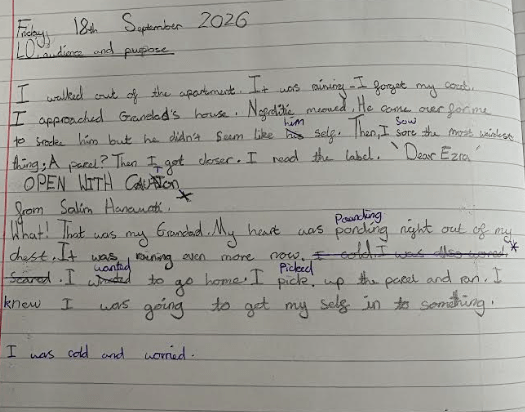
Aria
Spellings to be tested Friday 2nd October
Two-Syllable Words Containing Double Consonants
Spelling rule:
Some two-syllable words contain double consonants. Look carefully at the middle of the word and listen for the short vowel sound.
This week’s words:
1. address
2. different
3. difficult
4. opposite
5. possible
6. occasion
7. occasionally
8. suppose
9. appear
10. disappear
Remember:
Look carefully for the double consonant in the middle of the word.For example:
– different
– difficult
– opposite
– possible
Can you spot the double consonant in each word?
PE
Outdoor and adventurous activities (OAA)
We have had a fantastic afternoon today, taking part in some orienteering as part of our OAA topic.
In groups, children were handed an ariel view of our school with points marked out for them to find. Children then used their map to find the orienteering points. Each point had a letter.
Once children had collected all the letters, they had to work out the missing sentence. After some excellent teamwork and a few clues, they solved the puzzle and discovered the hidden sentence.
OAA is an excellent topic that allows children to be outside whilst solving problems and working together as a team. Communication, listening and perseverance are all skills required to succeed here.


Living and Learning – I use good manners.
This week, our Living and Learning statement was: ‘I use good manners’.
We talked about what good manners look and sound like and why they’re important. We decided that using good manners is a simple way to show kindness and respect to the people around us.
We thought of lots of ways we can show good manners:

We also thought carefully about whether ‘please’ or ‘thank you’ is more important. There were some brilliant ideas and we realised there isn’t always one right answer!
Help at home by looking out for good manners this week and noticing when they happen. You could ask, ‘How did your good manners make someone else feel?’
PE- Catch the Butterfly
This term we are focussing on multi-skills, to support building on our fundamental movement skills. This week we have been working on throwing and catching. Our learning objective for this lesson was to be able to catch an object thrown by someone else.
We started this individually, throwing and catching bibs in the air – this was our butterfly. To make this more challenging for the children they were then asked if they could throw the bib into the air and count their claps before catching it. We introduced more challenges such as touching our heads, shoulders, knees and toes before than practicing in pairs.
Next week, we will be looking at adapting the game by introducing other resources, using different sized balls and seeing if they can come up with their own scoring system, such as allowing the ball to bounce once before they can catch it.


Help at home: Practice catching the butterfly at home. A tea towel or small item of clothing would work in the same way. You could challenge yourself further by seeing how many claps you can do before you need to catch the butterfly.
History – When was Ancient Greece?
This week in history, we have been learning about when the Golden Age of Ancient Greece took place. We worked together to create a large timeline using multilink cubes, placing and labelling some of the important people, events and periods we have already explored in our history lessons.
The children thought that the coronavirus felt like a long time ago so seeing the timeline stretched out in front of us helped us understand chronology and showed us just how long ago the Ancient Greeks lived.
The children were amazed by how far back in history we had to travel to reach Ancient Greece!
Help at home: Can you create your own mini timeline? Include Ancient Greece (800-300 BC) alongside other significant dates for you as a family (this could be the year that family members were born and any other historical events or eras that you find interesting.)
