
A Super Busy Week-Sports Day and Transition Morning
Wow! What a busy and exciting week we’ve had!
It all started on Tuesday morning with our Early Years Sports Day. Every single child was absolutely amazing! It was so lovely to see their enthusiasm, determination, and fantastic participation throughout the morning. They tackled every race and activity with big smiles and lots of energy – they really did us proud!
A huge thank you to all the families who came along to cheer the children on. Your support made the morning even more special, and it was wonderful to see everyone enjoying the event together.
On Thursday, our Reception children had a fantastic time visiting their new Year 1 classroom. They were excited to meet their new teacher, Mr Nash, and explore their new learning environment. They loved getting a taste of what life in Year 1 will be like – in fact, some of them enjoyed it so much they didn’t want to come back!
Reports
Year 5 reports have been sent out to parents/carers today. I’d like to start by saying how proud I am of all the children this year. It’s been a pleasure to teach all the children and they should be really proud of themselves. I feel privileged to have played a small part in their continued development, both with their academic learning and their journey in being happy, healthy and successful human beings.
Please, if you have any comments, questions or concerns, contact me – I’m always happy to help.
Thanks, parents and carers, for your continued and fantastic support of your children at home – it really does make a difference.
Take care
Mr Freeman
DT – Hand Puppets in Year 2
Today, Year 2 proudly completed their hand puppet projects! Throughout their topic lessons this half term, the children followed the design process, just like real designers. They planned their ideas, selected suitable materials, made their puppets and evaluated their finished products.
To create their puppets, the children carefully sewed the front and back pieces together using either an over stitch or a running stitch, showing great patience.. They then brought their designs to life by adding decorative features such as eyes, felt shapes and sequins.


Maths – Coin recognition and counting
In maths, we’ve been learning all about money. We’ve been recognising and sorting 1p, 2p, 5p and 10p coins before using them to help us count in 2s, 5s and 10s. We’ve enjoyed spotting patterns in the coins and using our counting skills to work out different totals.
One of our favourite activities has been playing the Toy Shop Money game. It’s a fun way to practise recognising coins and paying for different items.

Help at home by letting your child help count out small amounts of money when shopping.
The Magic Box
This week in Writing, we have been exploring the poem The Magic Box by Kit Wright. The poem uses imagination to describe all the wonderful and unusual things that could be kept inside a magical box.
Over the next few lessons, Year 3 will be writing their own versions of the poem, using their creativity to think of special objects, memories, sounds, smells and dreams they would like to keep in their own magic box.
To help prepare, why not have a chat at home? Ask your child:
- What would you put in your magic box?
- Would it hold real things, imaginary things or special memories?
- What sounds, smells or feelings might be inside?
Encouraging your child to think creatively and jot down a few ideas will help them feel confident and inspired when they begin writing their own poem in class. We can’t wait to read all of their imaginative ideas!

Food Technology – Secret Garden Salad Recipe
Y4 enjoyed making their Secret Garden Salad Recipe and evaluating it with their friends.

I like the taste of the dressing – Cameron
I like all of the different flavours mixed together – Orianne
I would give it nine and a half out of ten. I like the salad and it’s good for you – Max
I don’t like the spring onions; they taste too strong – Jack D
I like the salad but I don’t like the dressing – Hattie
Help at home: Recreate the recipe at home making some adjustments to the recipe based on what your child thought about the original recipe.
Tidy week 2
This was our second week using the book Tidy by Emily Gravett. This week we practised orally retelling the story using actions to help us remember.

Art
This half-term, our featured artist is Alexander Calder. Calder was most well known for his sculptures and mobiles. We explored photographs of his artwork, discussing the different shapes, colours and how his creations made us feel. Inspired by Calder’s moving mobiles, we designed and made our own using plastic bottles, paint and glitter. They are now hanging from the classroom ceiling for the wind to catch and make them move.
Sports day reminder
Sports Day is on Tuesday at 9.30am. Please ensure your child comes to school wearing PE kit. They should also wear a t-shirt in their team colour. As the weather is expected to be warm, please make sure your child brings a named sun hat and has sun cream applied before they come to school.
Meet your new teacher
On Wednesday morning, the Reception children will spend some time getting to know their new teacher and exploring their new classroom. This is an exciting part of the transition process and helps the children feel more confident and familiar with their new learning environment.
Thank you to all the parents and carers who joined the transition Zoom meeting. We hope you found the session useful. As always, if you have any questions, comments or concerns, please don’t hesitate to speak to me.
Commotion in the Ocean
“There’s a curious commotion
At the bottom of the ocean
I think we ought to go and take a look…….”
So we did!
We thoroughly enjoyed continuing to read this rhyming story this week. We retold the story using props, helping to develop our language and storytelling skills.
We also created our own sea creatures using a large sheet of paper we had to use our observational skills to draw a range of different sea creatures.
In our maths work, we have been exploring the language of capacity in the sand and water areas. We have been learning to describe containers as full, empty, or half full.
‘My water bottle is full. It’s at the top!’
‘My bucket is empty, it’s all gone on the flowers!’
Help at home: Why not encourage your child to practise this at home by filling different containers with water during bath time or helping in the kitchen?
DT – Food and Nutrition
As part of our Design and Technology learning this half term, we’ve been exploring food and nutrition by making our own healthy wraps. Before we started, we talked about the importance of choosing a balanced selection of ingredients, including protein and vegetables.
We carefully prepared our fillings, safely cutting cucumber with the claw grip. We then spread cream cheese onto our tortilla wraps, chose our favourite fillings and rolled them up tightly. It was great fun tasting our finished wraps.
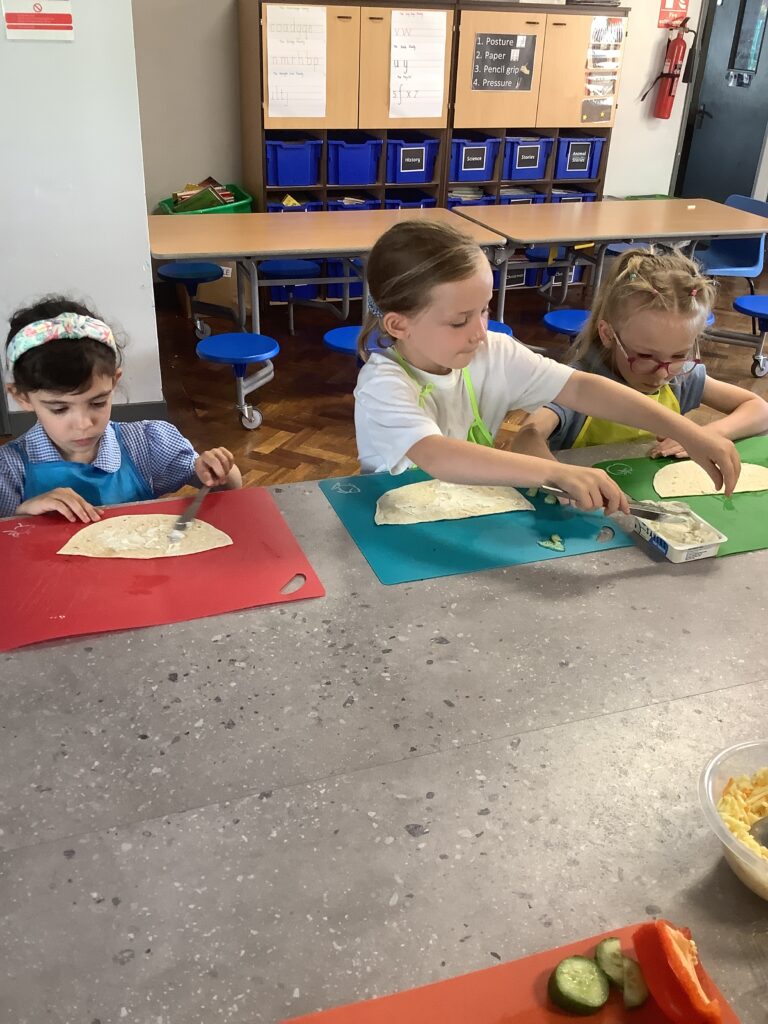

Help at home by making a healthy wrap together. Encourage your child to choose a variety of vegetables and a source of protein.
Here’s the recipe we followed at school:
Ingredients
tortilla wraps (one wrap between two children)
something sticky to hold it together (such as hummus or cream cheese)
protein rich fillings (such as grated cheese, tuna or turkey)
other fillings such as peppers (snipped); cucumber (claw); lettuce (snipped)
Method
- Lay out the tortilla wraps.
- Prepare the fillings.
- Spread with the cream cheese or hummus.
- Select and add the fillings.
- Start at one side, roll up very tightly.
- Cut the rolled wrap in half.
Living and Learning – I can say one good thing about myself
This week our living and learning statement has been ‘I can say one good thing about myself.’
It has been lovely hearing the children be proud of themselves for a wide range of reasons.
