
Let’s make a splash

Starting school: Tips to try at home

Cities and seasides

Summer 2: Seaside and Cities
Welcome to our final half term in Reception our theme is Seaside and Cities and our focus books this half term are


Have a fantastic half term everyone and enjoy the sunshine but be safe. Drink lots of water and don’t forget to wear some sun cream.
Staying Safe
This week, we’ve joined in with school’s safety themed week. We’ve learnt all about staying safe in lots of different situations.
In school, we explored how we can stay safe in our classroom and outdoor areas. We also set up our very own Forest School area in our garden, Year 5 and 6 came to see us in big Forest school and reminded us how we need to use the equipment to keep ourselves and each other safe. Sarah has been great at making the rules simple enough for us to remember them. Thank you to the big kids for helping us stay safe.


We also talked about the important adults who help to keep us safe, as well as the ways we can help to look after and support each other.
To finish the week, we watched a road safety video and discussed different types of road crossings and how to cross roads safely.
Reminders
We will return for our final term on Monday 01 June.
Living and Learning – Staying Safe Week
We’ve had a very busy and exciting week of Living and Learning in Year 1 as we explored lots of different ways to stay safe and healthy. We enjoyed meeting visitors, learning new skills and sharing our ideas together.
Staying safe around dogs
We talked about how to behave calmly and safely around dogs and learnt what dogs might be trying to tell us through their body language. We finished by making some fantastic posters to share our learning.

Staying safe in the community
We were very lucky to welcome PCSO Louise to school. She taught us some important ways to stay safe in our community, including how to stay safe in cars and when crossing roads. We listened carefully and shared some brilliant ideas about making safe choices.

Digital footprint
We began learning about our digital footprint and how the things we do online can leave a mark. We talked about making kind and sensible choices online and why it’s important to think before we click or share.

Staying safe near water
We had a visit from the Rivers and Canals Trust and learnt all about staying safe near water. We discovered the meaning of SAFE, which stands for Stay Away From the Edge. We talked about how water can look calm but still be dangerous and why it’s important to stay with trusted adults.
How many hazards can you see in this picture?

Keeping our bodies healthy
Dave from d:side visited us and taught us lots about keeping our bodies healthy. We talked about the importance of washing, brushing our teeth, eating healthy foods and keeping active. We enjoyed thinking about the different ways we can look after our bodies every day.

Sun safety
We learnt how to stay safe in sunny weather. We talked about wearing hats, using sun cream, drinking plenty of water and finding shade to help protect our bodies from the sun.

Staying safe on bikes and scooters
We discussed how to stay safe when riding bikes and scooters. We talked about wearing helmets, staying alert and choosing safe places to ride. We also reminded ourselves why it’s important to be careful near roads and driveways.

Staying safe in the home
We thought carefully about ways to stay safe at home and worked together to create some important safety rules for different areas of the house. We had some thoughtful discussions and shared sensible ideas.

Health and hygiene workshop
We took part in a fun workshop about staying healthy and stopping germs from spreading. We learnt why washing our hands properly is so important and discovered that some illnesses may need antibiotics from a doctor. We even carried out a fun experiment using black pepper and water to help us understand how soap helps wash germs away.

Help at home by asking your child to share one safety tip they learnt this week and explain why it’s important. Practise some of our healthy habits together, such as handwashing, road safety or brushing teeth.
Maths Curriculum – Summer Update
I wanted to say a big thank you for all the support you have given your children to help improve their confidence with the addition and subtraction facts that we have been focusing on this half term. We have just completed their assessments and we are so proud of the progress they have made.
In line with guidance from the DfE, we have prioritised our maths curriculum to ensure that children move in to Year 3 with all of the core maths knowledge and understanding that they need. This means that next half term, the biggest unit of learning for Year 2 will be about addition and subtraction of two digit numbers. They will also do smaller units of learning about division, shape and measure.
If you would like any advice or support about extra practice you can do with your child at home please let us know.
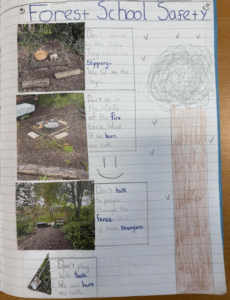
Forest School Safety: Supporting our younger pupils
As part of our Staying Safe themed week, Years 5 and 6 have been learning about staying safe within our school grounds. This half-term, it’s the turn of our younger children to experience Forest School. When speaking to Sarah and observing some of the younger children outdoors, we noticed that they might benefit from some guidance on staying safe.
So, off we went to Forest School to take some pictures of the activities available and any potential risks to educate the younger children about. We returned to make posters on staying safe whilst outdoors (examples below). Here at St James’, it is all of our responsibilities to keep our school a happy and healthy place to achieve and believe. With that in mind, we decided to visit our younger pupils to show them our posters. The conversations between children were fantastic and the younger pupils loved learning more about staying safe outdoors!


Staying Safe themed week
This week has been one of our Living and Learning themed weeks. We have been learning all about how to stay safe.
- Being Safe
We’ve been learning about what is appropriate and what is not using Rachel Brian’s book ‘Respect: Consent, Boundaries and Being in Charge of YOU’.

We’ve also thought about boundaries when negotiating about space and objects.

“If someone is feeling cross, they may need their own space.” Hunter
“Always make sure nobody is in front of you when you are on the slide or gym equipment.” Sophie
“In WUSU, don’t go too close to other people because you will trip them up when dancing.” Orianne
“When playing ball games, you need to check where you are kicking or throwing the ball.” Lillie-Jane
“Some people don’t like you in their personal space because they don’t want germs.” Aria
We’ve discussed about it not always being right to keep a secret if it relates to being safe.
“Even though it’s a secret, I would tell my Mum because it might be dangerous.” Lincoln
If something doesn’t feel right, in person or online, with someone we do or don’t know, we’ve talked about how we should Start Telling Other People (STOP.)
“If something doesn’t feel right you should just tell an adult. Just trust your instincts.” Hattie
- Health protection and prevention
We’ve been learning about safe and unsafe exposure to the sun and how to reduce the risk of sun damage including skin cancer.


5Ss for sun
- slip on a t-shirt
- slop on sun cream with a protection factor of 30 or more
- slap on a wide brimmed hat
- slide on some quality sunglasses
- shade from the sun wherever possible
We’ve had a very engaging session with D:Side learning about drugs and medicine.

- Personal safety
Louise Crossland (our PCSO) spoke to us about how to stay safe near roads and at the park.

We reflected on hazards that may cause harm, injury or risk:
– around water

“My Dad said the rocks near the river are really slippy.” Zachary
“The current might not look strong but it might still be strong.” Poppy
“If you swim out to the island in the middle of the river it is really deep and you could drown.” Violet
We discussed how we should always speak to an adult to check it is safe before going in water.
– on the road
We put our learning in to practice by going on a walk to the park, thinking about how to be safe near the road and at the park.

– with food

– in the home

and thought of ways to reduce these risks.
- Online safety
We learned that we need to be aware of our digital footprint.

- Citizenship: Living in the wider world
We thought about how the British values of the rule of law and individual liberty link to keeping us safe.
“Our parents have rules. It’s not to be mean – it’s just to keep us safe.” Max
“It is your body your choice. So you can decide whether you do something or not. You can always ask your parents too.” Orianne
- Christian values
We reflected on how the Christian value of courage to help keep us safe.
“If you are lost in a shop and need to ask for help you might need to be courageous to ask for help.” Lily
“It’s like D:Side Dave said, if one of your friends tries to get you to drink wine you need to be courageous to say no.” Poppy
“If your friend asks you to play in the road you could say it’s dangerous because a car might hurt you.” Cheyenna
Staying Safe Week
This week has been one of our Living and Learning themed weeks. We have been learning all about how to stay safe.
- Being Safe
We’ve been learning about what is appropriate and what is not using Rachel Brian’s book ‘Respect: Consent, Boundaries and Being in Charge of YOU’.
We’ve also thought about boundaries when negotiating about space and objects.
We’ve discussed about it not always being right to keep a secret if it relates to being safe.
If something doesn’t feel right, in person or online, with someone we do or don’t know, we’ve talked about how we should Start Telling Other People (STOP.)
- Health protection and prevention
We’ve been learning about safe and unsafe exposure to the sun and how to reduce the risk of sun damage including skin cancer.
We’ve completed some basic First Aid training to empower us to act calmly and effectively in emergencies.
We’ve had a very engaging session with D:Side learning about drugs and medicine.
- Personal safety
The Canal and River Trust led an assembly all about water safety.
Louise Crossland (our PCSO) spoke to us about how to stay safe near roads and at the park.
We reflected on hazards that may cause harm, injury or risk:
– around water
– on the road
– with food
– in the home
and thought of ways to reduce these risks.
- Online safety
We learned that we need to be aware of our digital footprint.
- Citizenship: Living in the wider world
We thought about how the British values of the rule of law and individual liberty help to keep us safe.
- Christian values
We reflected on how the Christian values of courage and perseverance might be needed to help keep us safe.
Help at home:
Please take some time to talk with your child about the learning we have covered this week. You could discuss:
- Who are the trusted adults they can talk to if something worries them?
- Why is it important to tell an adult if something does not feel safe or right?
- What should they do if they see something upsetting online?
- How can they stay safe near roads, water and at the park?
- Why is sun protection important?
- Which medicines are safe to take and who should give them medicine?
- What hazards can they spot around the home and how can risks be reduced?
- What information is safe to share online and what should stay private?
- How do rules and laws help to keep people safe?
Encourage your child to explain what they have learned about the STOP message:
Start Telling Other People if something feels unsafe, worrying or uncomfortable.