
JLT elections
With 14 strong candidates for the two positions of Year 4 JLT representatives, it was always going to be a tough decision for our voters!

Today, many courageous Year 4 children spoke confidently to their peers explaining why they would be a great leader. All children presented persuasive and coherent arguments for why they should be chosen.
As a democracy, each child had one vote which they cast in private in the voting booth. This was then submitted anonymously in the polling box.


I am incredibly proud of all the children who nominated themselves for JLT as well as all the children who showed respect when listening to the speeches. Seeing this group of incredible young people makes me think our future is in safe hands!
Topic trip
Yorkshire Sculpture Park
Year 5 and 6 went on our first school trip of the year to the Yorkshire Sculpture Park yesterday. This was to enhance our upcoming art and sculpture topic next half term and to give the children some inspiration for sculpting.
Before talking about the trip, it’s important to acknowledge how fantastic our St James pupils were. All staff (and members of the sculpture park) commented on how well the children conducted themselves and how engaged they all were at all times. They represented the school brilliantly and I’m so proud to be their teacher.
In the morning, Year 6 went out on a guided tour around the park. We made sketches of small parts of sculptures (as they had so much detail within them). Children worked calmly and safely in the park and we really enjoyed exploring lots of different work by sculptors. We visited the Family of Man by Barbara Hepworth. Here we enjoyed viewing all the various designs and having our picture taken with them. We were also fascinated by the David Nash sculptures that all link to nature.
In the afternoon, we were able to view other sculptures around the park and explore. We visited the underground exhibition where William Kentridge’s The Pull of Gravity was being displayed. We absolutely loved this exhibition – the children could even get creative and make some of their own sculptures!
What a fantastic day!


The Yorkshire Sculpture Park – what a trip!
Years 5 and 6 went on our first school trip of the year at the Yorkshire Sculpture Park today. This is to enhance our upcoming art and sculpture topic next half term and to give the children some inspiration for sculpting.
Before talking about the trip, it’s important to acknowledge how fantastic our St James pupils were. All staff (and members of the sculpture park) commented on how well the children conducted themselves and how engaged they all were at all times. They represented the school brilliantly and I’m so proud to be their teacher.
In the morning, Year 5 went out as a group to explore the park. We took our sketch books to practise drawing small parts of sculptures (as they had so much detail within them). Children worked calmly and safely in the park and we really enjoyed exploring lots of different work by sculptors. We then visited the underground exhibition where William Kentridge’s The Pull of Gravity was being displayed. We absolutely loved this exhibition – the children could even get creative and make some of their own sculptures!
In the afternoon, we took part in a workshop led by an artist from the YSP. They led us around different sculptures and gave us some top tips for drawing and sculpting. Here are some pictures from our fantastic day!


Help at home:
Next half term, we will be focussing on three key sculptors: Henry Moore, Barbara Hepworth and Thomas J Price. Perhaps research some of their current work – are there any similarities and differences between the sculptors?
Adding tens and ones
We have continued to explore tens and ones in our maths lessons.
This week, we have been adding tens and ones together.
We learned that if we have 40 (or 4 tens) and we add 3 ones, the total is 43.
We used Base 10 equipment to help us see this visually. By finding the correct number of tens and ones, we could clearly see the total amount when they were added together.
We are becoming more confident at recognising how numbers are made up of tens and ones and using this to help us add!


Help at home: Can your child choose some tens and ones to add together. They could draw out the Base 10 or show you a part whole model that we have been using.
Henri’s Scissors
This week we have been reading Henri’s Scissors by Jeanette Winter.
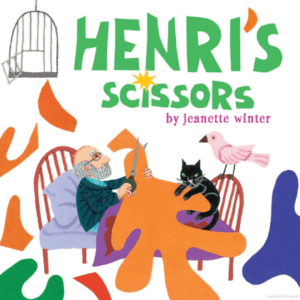
The story is a biographical children’s book about the famous artist, Henri Matisse. We learned about his life and discovered how, even when he became unwell and could no longer paint, he continued to make beautiful artwork by cutting bold shapes and colours to create collages.
Our word of the week was artist. We talked about different types of art and artists, introducing new vocabulary such as sculptor, sculpture and collage.
Then, we became artists ourselves by creating our own colourful collages – just like Matisse!
We used our language and communication skills to explore and respond to Matisse’s artwork. We looked closely at the colours, shapes and patterns and thought carefully about which pieces we liked and why.
We also discussed questions such as:
- Why do you think the artist painted this?
- Which is your favourite, and why?
Here are some of our thoughtful responses:
I like the green shapes, they look like emeralds.
I can see pink and purple, I like that.
I like the white bit, it is a funny shape.
Phonics
This week, children have been learning the phonemes (the sounds that letters make) h, b, f, and l. They’ve also been practising writing the graphemes (the written letters) for these sounds.
We’ve also learnt a new tricky word: the.
A tricky word is a word that can’t be sounded out using phonics – it’s one they simply have to learn by sight.
The children now know three tricky words: I, is and the
Help at Home: You can support your child’s learning at home by writing these tricky words on pieces of paper or sticky notes and placing them around your house. Keep challenging your child to read them whenever they see them – the more practice, the better! These words need to be recognised instantly, just by looking.
Poetry Basket
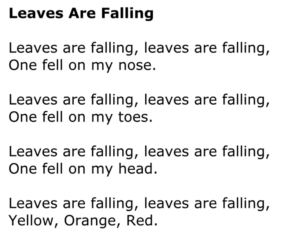
Children love listening to and joining in with poems each week. We learn a new poem every Monday and recite it together throughout the week.
Saying the poems out loud helps us focus on sounds, rhythm and rhyme, which supports our early reading skills. We’ve noticed that some poems have a fast and lively beat, while others are slow and gentle.
Maths
In Maths, we’ve been using our subitising skills to identify patterns up to 4.
Subitising means being able to see a small number of objects and know how many there are without counting – for example, recognising that there are three dots just by looking.
We’ve been using our subitising skills playing bingo this week.
Help at home – autumn leaves and conkers.
If you go on a walk this weekend, we’d really appreciate donations of dry leaves to help us with an art project next week. We also need some conkers and acorns to use in our maths learning – see how many you can find! Thank you for your support.
Have a happy and healthy weekend
Mrs. Kendrew, Mrs. Rippon, Miss. Feldman, Mrs Linton, Mrs Cairnes and Mrs Small
Living & Learning – Protected characteristics
Our Living & Learning statement this week was:
I understand some characteristics are protected by law.
This week we learnt about the protected characteristics. We discussed what they are and how and why they’re protected.
What is discrimination?
Discrimination is defined as ‘the unfair treatment of people because of who they are or because they have a certain characteristic(s)’. We discussed examples and the impact of discrimination.
Protection from discrimination
We discussed how the protected characteristics are protected by law – The Equality Act 2010 protects people from discrimination based on protected characteristics.
We reminded ourselves of a helpful way to remember the protected characteristics by using the mnemonic:
DR GRAMPSS
Disability
Race
Gender reassignment
Religion or beliefs
Age
Marriage or civil partnership
Pregnancy and/or maternity leave
Sex
Sexual orientation
We are already pretty confident recalling the protected characteristics so we thought deeper about why they are important. What would our world be like if we didn’t have protected characteristics?
Can everyone achieve?
Later in the week, we watched a video celebrating the life and achievements of Jane Goodall (Watch Newsround video here) who is our featured scientist of the half-term. We discussed how important it is that people are able to have the same opportunities regardless of their sex (one of the protected characteristics). In the 1960s, when there were very few female scientists, Jane made significant contributions to the fields of conservation and anthropology. We hope that The Equality Act (2010) will mean that anyone who wants to be a scientist can be one without facing discrimination.
Help at home: Discuss why you think our world is a better place for having protected characteristics.
DT Food – Banana sandwiches
As part of our Design and Technology learning, the children get three opportunities each year to prepare food and this week was one of them!
This time, we made banana sandwiches using lots of different skills. We started by reading the recipe together and chatting about what we might change to make it our own.


We also talked about the importance of good hygiene and how to stay safe in the kitchen.
We stayed safe by:
- tying up long hair
- washing our hands
- chopping away from our bodies
- trusting the adults
After tasting their creations (always the best part!), we evaluated how they turned out – thinking about what went well, how closely we followed the recipe and what we might do differently next time.
The hardest part was:
- chopping the banana
- spreading the cream cheese
- putting the slippery banana on the bread
I liked it because:
- bananas are my favourite
- the cream cheese was nice
- it was a good little challenge
I disliked it because:
- the cheese was too strong
- the cheese and banana didn’t go together
- the banana was too slimy
Next time, I would:
- try jam instead of cream cheese
- add some strawberries
- add butter
- use less banana

Help at home by watching some of these fantastic cooking videos. If you try any of these recipes at home, we’d love to see the results.
Living and Learning: I respect others and myself.
This week, Year 5 have been focussing on protected characteristics. The children recalled all nine very well (shown below). In our lesson, we focussed on the reasoning behind having protected characteristics in this country and where they originated. The Equality Act 2010 was introduced, making any discrimination of these characteristics illegal. Protected characteristics are in place to prevent the mistreatment and discrimination of people.

We then went on to discuss that treating people fairly isn’t always about treating people equally. Sometimes, adaptations need to be made so that everyone can have the same opportunities to be successful. Have a look at the picture below – do you think this is fair, even though everyone has been treated the same?

Help at home:
Our Philosophy Friday question this week: Is it always fair to treat everyone the same? Have a chat with your child about this at home – what do you think?
Health and Hygiene in Science
This week, Year Two began their new science topic all about humans, health, and hygiene.
In today’s lesson, we learned about the famous nurse Florence Nightingale and how her simple ideas about keeping hospitals clean completely changed healthcare. The children discussed why washing hands and staying clean is still so important for our health today.
To explore this further, we carried out an experiment using bread.
-
One slice of bread was placed straight into a sandwich bag without being touched – our control slice.
-
Another slice was passed around by everyone before washing their hands (straight after break).
-
The final slice was passed around again after everyone had carefully washed their hands with soap and water.


The children made some brilliant predictions about what might happen over the next two weeks:
“I think the dirty hands bread will go green and fluffy!” – Luna
“The clean hands bread might stay the same because there won’t be any germs on it.” – Niyah
“I think all bread grows mould, but the dirty one will do it faster.” – Jolyon
We’ll keep a close eye on our bread bags and check back in two weeks to see which slice grows the most mould.
From Reading to Creating!
This week, Year 3 were inspired by our reading text all about Sophia, a young girl who won an art competition and had her painting displayed next to the famous artist L.S. Lowry!
Throughout the week, we explored the writer’s choices in the text and discussed how these choices help us, as readers, to picture the story and feel inspired.
One pupil in particular was so moved by Sophia’s story that he decided to recreate one of L.S. Lowry’s iconic “Matchstick Men” paintings. His artwork truly captures Lowry’s unique style and we all think he’s done an amazing job!

Well done for showing such creativity and enthusiasm and well done to all of Year 3 for another fantastic week of reading, discussion, and imagination!
Help at home: Ask your child to retell the news report.