
Feeling Festive
On Wednesday, the Nursery children enjoyed making their Christingles.
A Christingle is a symbolic orange decorated with raisins on sticks, a red ribbon and a candle. It is used in church services, around Christmas time, and represents Christ as the Light of the World. Each part of the Christingle holds specific Christian meanings.
Orange: Represents the world.
Red Ribbon: Symbolizes Jesus’s blood and love.
Four Cocktail Sticks: Represent the four seasons or directions (North, South, East, West).
Fruit: Symbolizes God’s creation and blessings.
Candle: The central symbol of Jesus as the Light of the World, bringing hope into darkness.


Sculpting with Soap!
To conclude our art topic this half-term, Year 5 have been creating sculptures made from bars of soap. The children began by sketching a few real sculptures, made by our key artists (Henry Moore, Barbara Hepworth and Thomas Price). Then, the children used inspiration from each sketch to make a new sculpture of their own.
The children had a range of mediums to use: a spoon; a pencil, a paperclip; other piercing tools; and a wet paper towel. Everyone listened very carefully when the process was modelled by their teacher and followed each step well. Pupils really enjoyed this hands on task, and have gone on to make multiple soap sculptures each! Here are some images of the children carefully carving:


Help at home:
Some Year 5 children have already explored this activity at home with other family members. Maybe this is something you could do, too? Here’s a list of equipment you’ll need:
- soap
- pencil
- wet paper towel
- dry towel
- spoon
Living & Learning – I can give and receive compliments
This week we’ve been thinking about the power of compliments. Compliments are wonderful to receive and lovely to give. We thought about how “I like your hair” might not be as meaningful to someone as “I admire how creative you are.”
Fortunately, Year 4 had lots of compliments to share with each other. Here are some of the most popular words used:

We also thought about how we might react when someone compliments us. We talked about how we might feel embarrassed but how we also might respond by saying thank you, smiling or giving a compliment back.
These are the words we thought of when we thought about how we might feel when someone gives us a compliment:

Help at home: A well-placed compliment can make someone feel valued, seen and appreciated. For children and adults alike, receiving genuine praise can boost self-esteem and strengthen emotional well-being. You could play a compliments game at home, taking it in turns to compliment someone in your family. Challenge your child to explain what makes a compliment a meaningful one.
Dictation helps the children develop their spelling, handwriting, grammar and listening skills


Maths – Patterns
This week, in maths, we’ve been learning about 2D shapes and patterns. Our focus has been on aligning shapes with one another by rotating them to connect their edges.
The children have been developing their spatial reasoning skills by placing and rotating shapes to create images.

We’ve also enjoyed exploring patterns. A pattern is a repeated arrangement of shapes, lines or colours. We’ve been noticing and describing the characteristics of patterns and had a go at making some of our own.


Help at home by making some images or patterns yourself.
Recount Writing
This week, the children wrote their own independent recounts of making their banana sandwiches and they were fantastic. Using what they have learned this half‑term, they included expanded noun phrases (adjective, adjective noun) and time connectives, remembering to use a comma after each one.


The class impressed me with their careful handwriting, neat presentation, and brilliant word choices. They used adjectives such as soft, bright, crumbly, scrumptious, and delicious to describe the process.
Writing – Nouns and Adjectives
In writing, we’ve been learning about nouns and adjectives.
- A noun is a person, place or thing.
- An adjective gives information about a noun.
We’ve had lots of fun using nouns and adjectives to describe different parts of a monster, inspired by Not Now Bernard by David McKee. The children thought carefully about what the monster looks like and used adjectives to add information.

The monster has five friendly eyes.
He has sharp, pointy horns on top of his red head.
It has gigantic, purple feet.
The monster has rainbow fur all over its round body.
Help at home by choosing an object at home (like a toy or a piece of fruit) and ask your child to name the noun then think of some adjectives to give information about it.
Amazing Gymnastics
Throughout this half term, the children have been developing their gymnastic skills. The class have learnt about the importance of spacial awareness. This has helped with balance, coordination, and safety.
Over the last few weeks, the children have been given the opportunity to put their gymnastic skills into practice by using the big apparatus.
It was lovely to see them, taking safe risks, being resilient and thoroughly enjoying themselves.


Living and Learning: I can give and receive compliments
This week in Year 3, our Living and Learning focus is I can give and receive compliments. We talked about what compliments are and why they are important. We discussed how a kind word can make someone feel happy, valued and confident.
As a class activity, each child wrote a compliment to themselves: something they are good at or something they like about themselves. Then, we did a fun activity: each child picked someone else’s name out of a hat and wrote a compliment about that person.
It was lovely to see how thoughtful and kind the children were when writing compliments for each other. They clearly understood how good it feels to receive positive words and how powerful kindness can be.
Help at home: Before bed, say one thing they did well that day.
Food Technology – Tomato and lentil soup
This week, Year 4 have loved making tomato and lentil soup in Food Technology.
We thought carefully about how to keep ourselves safe.
- We washed our hands to make sure we used good hand hygiene to help keep us healthy.
- We wore aprons to protect our clothes.
- We used the bridge cutting method and the claw cutting method to cut up our ingredients to keep our fingers safe.
- We were very careful near the hob which got very hot!
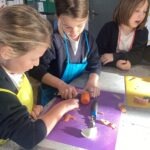
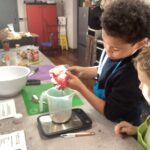
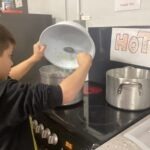
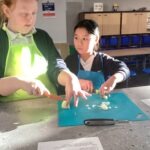
The soup was a hit in the taste test – we hope you will enjoy making the recipe again at home!
Help at home: Next time you are peeling or cutting vegetables, ask your child to show you how they have learnt to do this safely.