
Philosophy Friday: Sprituality
Today’s philosophical statement:
Always. Sometimes. Never.
Being spiritual links to religion.
The children were given time to think deeply about this statement and whether they believe it is always, sometimes or never true. During these sessions, children are prompted to use a variety of sentence starters to encourage meaningful discussion (shown below).

The responses from pupils were articulate and well-thought. They showed good voice projection, too. Here are some snippets of our discussion:
Sometimes
Feeling spiritual can be as simple as watching leaves fall from a tree, and that’s not a religious thing. However, it could be linked to religion to some people if that’s what they choose to connect with. – Jack F
Sometimes
Because having a connection to the world is great. – Elijah
Sometimes
You don’t need to be religious to be spiritual. Spirituality can link to God but it can also link to nature, yourself, our environment and our friends and family. – Hattie
RE – Creation or Science: conflicting or complementary?
To support our learning and understanding of our RE topic: Creation or Science, we have been learning about different peoples’ views. Many of these people are scientists who believe strongly in God.
To connect further with other beliefs, we invited Reverend Peat into school to answer some questions we had. We had such an informative chat and we were able to take time to reflect on our own understanding whilst connecting with Reverend Peat’s beliefs.
It was a very enlightening morning and one where we were all able to contribute. One thing that became clear is that we can’t possibly always know the answers, in this case the answer to who created the earth? By answering questions, we found that this led to further questions. This curiosity is so important in all of our learning. It was lovely to see the children engage in the discussion and be curious about our topic.
As part of our RE learning, we have an RE ‘big book’. Here are some pictures reflecting today’s learning:


Living and Learning: I Respect Others
I respect others is our living and learning statement this week. Year 5 have been recapping what discrimination means and which of our characteristics are protected under the Equality Act.
Discrimination – the unfair treatment of people because of who they are or because they have a certain characteristic(s).
We looked at some made up scenarios where people may or may not have been discriminated against and linked our protected characteristics (shown below):

The Equality Act, introduced in 2010, protects us from discrimination when:
- at work
- in education
- using public services
- buying or renting a home
- buying goods or services
- a member or guest at a club
Once our learning on this was secure, we looked at some more scenarios. The children had to decide whether the actions described were legal or illegal.
Help at home:
There are some scenarios below for you to discuss with your child. The children are really good at knowing and naming our protected characteristics, but we want to embed why they are so important to us in society. Can you decide whether these actions are legal or illegal?
A woman has worked at a bank for three years. When she tells her manager that she will be taking time off to have a baby, her manager says that they will have to sack her and find a new person for her job.
A football team for players who are deaf will not accept a player who is not deaf.
A couple want to book a hotel for their wedding but the owner of the hotel says that they do not host same sex marriages.
A person applies for a job with a business. At the interview the owner of the business says that they have the right skills for the job but they don’t think they would ‘fit in’ with the rest of the team because they are from a different country.
The Story of Nehemiah Rebuilding the Wall
Each half-term, pupils learn about a Bible story, linking to one (or more) of our Christian values. We’ve been learning about ‘The Story of Nehemiah Rebuilding the Wall’, and on Thursday’s (during Collective Worship), one class per week will retell the story and discuss values and messages within.
Year 5 decided to delve deeper into this story in our reading lessons. We read the story many times, practising fluency and prosody. We then reflected and tried to connect with Nehemiah, his thoughts, his words and his actions. The pupils put themselves into the shoes of Nehemiah and found many links to his efforts and our Christian values. Here are some examples:

Nehemiah needed to show peace because his enemies were trying to stop him and attack him and he chose to leave them alone – Freddie
Nehemiah needed courage to go and ask the king to leave for Jerusalem to rebuild the wall – Sophie
Help at home:
If you’d like to read this Bible story with your child and reflect further, I’ve attached it below. Perhaps talk to your child about what they would have done in Nehemiah’s shoes?
The Story of Nehemiah Rebuilding the Wall
(Nehemiah 1–6)A long time ago, the city of Jerusalem was in trouble. Its big, strong wall had been broken down, and the gates were burned. Without walls, the people were not safe. Enemies could come and go as they pleased. Far away in a land called Persia, a man named Nehemiah worked as a cupbearer for the king. One day, he heard about the broken wall in Jerusalem and how sad the people were.
Nehemiah’s heart was broken. He wanted to help. He prayed to God and asked for strength. Then, he went to the king and said, “Please let me go to Jerusalem and rebuild the wall.”
The king agreed and gave Nehemiah everything he needed for the journey.
When Nehemiah arrived in Jerusalem, he looked at the broken wall. Stones were everywhere. It was a huge job. But Nehemiah didn’t give up. He called the people together and said, “Let’s rebuild the wall! God will help us!”
The people cheered and started to work. Some built the gates, some lifted stones, and others watched for danger. Everyone had a job. But not everyone was happy. Some enemies laughed at Nehemiah. “You’ll never finish!” they said. “That wall is too broken!”
Others tried to stop the work and even threatened to attack the workers. But Nehemiah didn’t give up. He said, “Don’t be afraid! God is with us!” He told the people to work with one hand and hold a sword in the other, just in case.
Day after day, brick after brick, the wall slowly grew taller. The people got tired. Their hands hurt. The sun was hot. But still, they worked.
Nehemiah kept encouraging them. “We’re doing God’s work,” he said. “Let’s keep going!”
Even when the enemies tried to trick Nehemiah into stopping, he said, “I’m doing a great work, and I will not come down!”
Because Nehemiah and the people didn’t give up, they finished building the wall in just 52 days! Everyone was amazed. The wall was strong again, and the people were safe. They had done something incredible, because they worked together, trusted God, and persevered.
The Mysterious Parcel – Recount Writing
Today, Year 5 began writing our first official piece – a narrative recount. The purpose of a recount is to re-tell events and describe what has happened. We are basing our recount on our class novel, Secrets of the Sun King. Let me set the scene…
Year 5 walk in. Lights are out. Rain pouring from above. Silence stretched out across the classroom (or street in our narrative). We have taken the identity of Lilian – a young girl on her way to her grandad’s house. She becomes unsettled yet curious about a mysterious parcel on Grandad’s doorstep. Here’s a starting paragraph we made and acted out together:

The children have really enjoyed beginning their own recount of events. Here are two examples so far:

Freddie
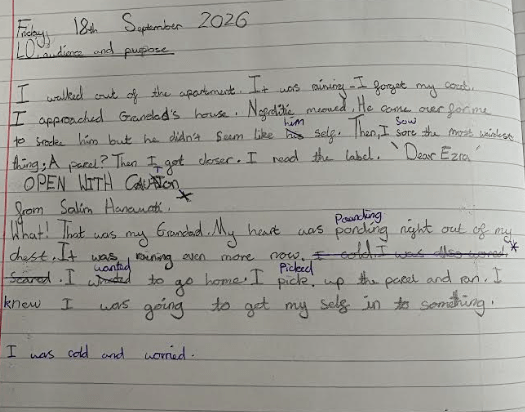
Aria
Living and Learning: I know and show Christian Values
The class have really settled in to life as Year 5 pupils this week. As we begin new areas of learning, we’ve made sure to talk about how our Christian values may help us become even better learners and citizens.
Here are our Christian values and KS2 definitions:

In our circle time this week, we reflected on, and discussed, the following statement:
I know that it’s OK for me to make mistakes and learn from them
The children came up with some really good links between making mistakes and our Christian values.
Making mistakes can help us learn more and persevere.
If we do something wrong, it’s important to show forgiveness to ourselves and other people.
Making mistakes can help us be courageous, like Lilian is in our class novel because she lost her grandad’s Egyptian vase and is now trying to get it back.
Help at home:
This half-term, we are focussing on one of the Christian values – perseverance. Talk to your child about what this means and how we can show perseverance in different ways at school and at home.
Speaking of perseverance…
Just take a look at how many fantastic reading records Year 5 have brought back in week one! The fact file task has been well and truly completed to a high standard – great work.
If your child has not yet been able to read at home or complete their reading record task, please remind them to do so. The deadline is Friday each week.

Living and Learning: I follow the school rules.
‘My thoughts are that rules keep us safe because without them, children wouldn’t have direction and wouldn’t know what is right and wrong.’
I understand your point of view, but what do you think about mine? Sometimes rules need to be broken in order to stay safe.
We then discussed how we can show the rules are being followed in school. We’ve made sure, during morning and afternoon registers, that we are replying respectfully and politely when called upon. We’re also working well in teams with our table caddies to keep them tidy and ready to learn.
There’s been a slight change to our 3,2,1, Stop. We are looking for children to respond to this with silent voices, positive body language and focus on the speaker. We do not require children to have empty hands anymore as children may feel more comfortable and focussed whilst holding something. We’ve discussed in class how to do this effectively and all children have responded well.
A Warm Welcome
Hello and welcome to Year 5!
After a busy Summer, our children (and teachers) have returned to school and are settling in, ready for a fantastic year. It was great to hear such happy and healthy memories from the children, and it was nice for them to ask about my holidays, too.
It feels like we have restarted exactly where the class left me in Year 3 – determination, hard-work and resilient learners keen to be the best version of themselves. I’m really pleased with how everyone has adapted to changes, as transitioning between classes can be overwhelming.
We can’t wait to really get stuck in to our learning (especially our new history topic involving Ancient Egypt). The children have shown excitement and have even brought in lots of books for others to read during our book club.

In our first history lesson, we recapped our knowledge of British and world history, using timelines to plot time periods. The children worked well with this, completing the task either independently or as a group.

Help at home:
Talk to your children about our learning from this week.
What have they enjoyed so far?
What are they looking forward to learning more about?
As always, if you have any questions, please don’t hesitate to contact me.
I look forward to another great year!
Take care,
Mr Freeman
Reports
Year 5 reports have been sent out to parents/carers today. I’d like to start by saying how proud I am of all the children this year. It’s been a pleasure to teach all the children and they should be really proud of themselves. I feel privileged to have played a small part in their continued development, both with their academic learning and their journey in being happy, healthy and successful human beings.
Please, if you have any comments, questions or concerns, contact me – I’m always happy to help.
Thanks, parents and carers, for your continued and fantastic support of your children at home – it really does make a difference.
Take care
Mr Freeman
Living and Learning: RSE Update
Year 5 are coming to the end of their RSE learning block. We’ve had some really positive and mature conversations about growing older, puberty and changes to expect in our lives.
“I’ve really enjoyed learning RSE. I really like the Ask-It Basket because it lets me write questions that I don’t like saying out loud.” – anonymous
“RSE is important because everyone will go through changes and I’ve learnt how to deal with them.” – anonymous
“I feel safe in school if anything were to happen unexpectedly. I have lots of trusted adults I can turn to like my teacher.”
Help at home:
Please keep allowing your child to talk about this learning. They may have further/ongoing questions as they transition into high school, so keep an open-book policy at home. Children struggle to talk about this learning as it makes them feel uncomfortable and strange, so please encourage a happy, healthy and safe talking environment.