
Wetherby Tennis Club visit
Year 5 and 6 were lucky enough to visit Wetherby Tennis Club today. We were invited along to hone our skills and display some of the attributes we have learnt in our PE lessons. We all thoroughly enjoyed the afternoon in the sun and we made all the staff proud.


Help at home – can your child show you some of the skills they have learnt today? Can you play a game as a family in your garden or at the park?
World Cup Writing: The Last Penalty
To help us get into the World Cup spirit, Year 5 took part in a writing workshop this week. Our goal was simple: to imagine the final penalty to win the World Cup was down to us. One chance, one opportunity. We wanted to create suspense and tension by describing the final moments before taking the penalty. The pupils enjoyed and engaged with this writing really well. When we had finished, the children used table partners to check, edit and improve their writing further. We then wrote up final pieces in books (examples below). Although the children didn’t have much time to write this piece, the pieces themselves are superb! We’re really pleased with how they read and we now understand what it might feel like to be in that situation for the players!
Here are just three examples, but well done to everyone in Year 5!
Emily M

Beau

Isla

Living and Learning: Relationships and Sex Education
This week, Year 5 have begun learning about relationships and sex education (RSE). Our first session (and circle time) was about the following learning objective: I know that ingredients for a happy and healthy relationship.
We began the session with some class rules. Rules are important because they help keep us happy, healthy and safe. The children now understand fully how to act and respond in our RSE lessons. Here area few of our rules:
- We will talk to someone we trust if we feel there’s a need to get help.
- We can use the ask-it basket box to ask questions .
- It’s not OK to ask personal questions of each other or the teacher.
- We will be kind and supportive of each other, listening and not interrupting.
- We will respect different opinions, situations and backgrounds.
We then discussed our thoughts and feelings around learning RSE. All feelings shared were absolutely normal and ok to feel. Some children may feel nervous, whilst others may be curious to learn more – whatever feelings we have are accepted and we’ll all fully respect each other.
Finally, we introduced the Ask-it Basket. The basket is a safe space for pupils to write down any questions, worries or concerns during our RSE learning. These will be checked after each section by the teacher and acted on accordingly. We’ll keep our questions anonymous as to not break any of our rules above. Once checked, if the teacher feels any questions may be appropriate to relay to the whole class, they may be discussed and learnt about together.

Help at home:
Please give your child opportunities at home to talk about their learning and to bring up any questions or concerns they may have. This can be a difficult and confusing part of life for children to learn about, so support both at home, and in school, is vital.
Forest School Safety: Supporting our younger pupils
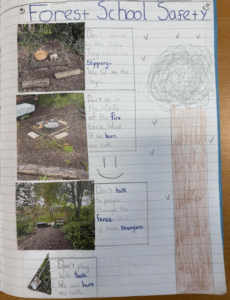
As part of our Staying Safe themed week, Years 5 and 6 have been learning about staying safe within our school grounds. This half-term, it’s the turn of our younger children to experience Forest School. When speaking to Sarah and observing some of the younger children outdoors, we noticed that they might benefit from some guidance on staying safe.
So, off we went to Forest School to take some pictures of the activities available and any potential risks to educate the younger children about. We returned to make posters on staying safe whilst outdoors (examples below). Here at St James’, it is all of our responsibilities to keep our school a happy and healthy place to achieve and believe. With that in mind, we decided to visit our younger pupils to show them our posters. The conversations between children were fantastic and the younger pupils loved learning more about staying safe outdoors!



Water Safety: Canal and River Trust
As part of our Staying Safe week here at St James’, we had an online meeting with Claire from The Canal and River Trust. The focus of the meeting was to educate us all about how to spot dangers around canals and rivers. The children enjoyed spotting dangers and explaining their reasons.
Claire ensured all the children know what to do should they see anyone in trouble at a river or canal. We should always call 999 in these situations. The emergency services will then aim to be there within 8 minutes!


Help at home – Can they speak about anything new they have learnt today? Visit the canal and river trust website – https://canalrivertrust.org.uk/.
PC Louise
Today, KS2 had a visit from PC Louise from West Yorkshire Police. She came in to talk to us about how to stay safe when we are out and about in our local community.
The first thing Louise spoke about was the importance of telling our parents or a trusted adult about where we are going and what time we will back home. This is crucial as it helps us to stay safe.
The next thing Louise spoke about was the importance of observing signs when we are out and about. Signs linked to roadworks, railway tracks, water and building sites were spoken about. She also mentioned that we MUST NOT enter sites that are abandoned for many reasons.
PC Louise spoke to us about what to do if we see someone acting suspiciously at the park or if there is someone who makes us feel uneasy. We should take ourselves away from that situation and make sure we speak to a trusted adult. If something doesn’t feel right – take yourself out of that situation.
Finally, PC Louise spoke to use about the importance of ALWAYS wearing a seatbelt when travelling in a car. It doesn’t matter if the trip only takes 10 seconds or if we are travelling at 5mph, ALWAYS WEAR A SEATBELT.


Help at home – speak to your child about how they can keep themselves when out in our local community.
Fire safety
As part of our school ‘staying safe‘ week this week, Year 5 and 6 had a visit from firefighters from Wetherby Fire Station. We were taught about what the firefighters do and the various jobs they are called to.
We learnt about prevention and the steps we can take to ensure that we reduce the risks of a fire breaking out in our homes – this includes not leaving devices with lithium-ion batteries plugged in.
Ensuring we have a bedtime routine is important too – ensuring ovens are off, devices unplugged, stairs clear and doors shut. The children were encouraged to speak to parents about an escape route should a fire break out, like what we do here at school.


The over-riding message from the visit was: GET OUT, STAY OUT, CALL 999.
Help at home – Ask your child:
- What jobs do the firefighters do?
- What are some of the common causes of fires in the home?
- How often should we check fire alarms at home?
- How many smoke alarms should we have in our homes?
- Which devices have lithium-ion batteries?
- What should you do if there is a fire in your home?
Reading – The Amazon Rainforest
This week, Year 5 have been learning all about deforestation impacts on the Amazon Rainforest. To do this, we’ve used an advert by Greenpeace UK called ‘There’s An Orangutan In My Bedroom. There is also a book for this story by James Sellick. Here’s a link to the video if you wish to watch it at home together:

there’s a rang tan in my bedroom – YouTube
In this advert, we find a confused yet inquisitive orangutan in a girl’s bedroom. It seems to be messing up her living space and becomes very annoyed seeing a chocolate bar and some shampoo containing palm oil. After initial anger, the girl becomes invested in why the orangutan is in her room. She learns that the orangutan has nowhere else to go as there are humans in the Amazon, destroying it’s home. The girl feels sympathetic and motivated to then help the orangutan with this issue. Finally, she calls for anyone watching to join the fight against deforestation and for us to be wary and mindful of the items we’re buying for our homes.
The learning from Year 5 around this issue has been fantastic. For example, we began by thinking about how the girl’s emotions change through the video and why this may be (shown below).

Then, we decided to do some acting of our own. The children split into groups and had some time to plan out their recreation of the advert. They then performed to the rest of the class, and all acts were absolutely brilliant! After lots of positive and constructive feedback, we created some reflective statements to use when performing.
When performing, it is vital to look up at the audience.
When performing, it is vital to share speaking parts equally.
When performing, it is vital to project your voice and use actions.
We were so proud of our performances, so we decided to take it one step further – to perform to the whole school in Friday’s collective worship! Year 5 were absolutely fantastic and had clearly taken their feedback on board. Here are some pictures of the performance!

Help at home:
Watch the video at home together. Is there anything you could do to support the prevention of deforestation? Next time you go to the supermarket, are there options that don’t contain palm oil? Maybe a healthier alternative over a chocolate bar, too?
Perhaps you could explore James Sellick’s book on this issue – There’s a Rang-Tan in my bedroom.
Science – Soluble vs Insoluble
This week, Year 5 were investigate the following enquiry question:
Which substances dissolve in water?
In science, we follow a three-step process: to plan; to do (and observe); and to evaluate.
In our planning process, we had to thing about which variables are going to stay the same (controlled) and which variables are going to change (independent).
Controlled variables (stay the same):
- amount of water
- amount of substance in each cup
- amount of stirs per substance
- temperature of water
- time limit
Independent variables (change)
- type of substance
Once we were all prepared, we made some predictions. The substances being tested were: salt, sugar, sand, rice, coffee, flour.
I don’t think rice will dissolve because we cook rice with hot water and it doesn’t disappear – Ethan
I think sugar is soluble because people drink tea which can have sugar in – Isla
Coffee is soluble because loads of adults drink it – Vinnie
Then it was time to conduct our experiment. The children worked really well in small groups and stayed safe throughout. Once finished, we discussed our findings and evaluated our results. Here is an example of our class evaluation:

Help at home
Maybe investigate one of our further suggestions at home?
Summer Learning Journey
After a well-deserved Easter break, the children have returned to school happy, healthy and well-rested. Here is a quick preview of Year 5 learning over the next five weeks!
Writing:
The children are currently working on how to punctuate speech correctly. This will lead nicely into writing our own short narratives with some character conversation. So far, we’ve look at punctuating speech with the reporting clause at the beginning, and at the end, of a sentence. Here’s some examples below:
“I really wish one of these paper planes would work properly,” Jack muttered.
Jack muttered, “I really wish one of these paper planes would work properly.”
Reading:
We’ve been reading a novel called The Explorer by Katherine Rundell – a story of four children lost in the Amazon Rainforest following a plane crash. So far, we’ve met Fred, Con, Lila and Max. We’ve realised that these characters (and the pilot) were the only ones on the six seater plane as it went down. In our reading lessons, we’ve been inferring more about our characters through the way they speak to each other and their actions. Fred is an older child who is inquisitive and looks after others. Con is witty and can come across as rude with her sarcastic tone. Lila is quiet and cares for her little brother, Max. Max is very young and doesn’t communicate much, but he is afraid of the situation they are in.
Maths:
We’ve started looking at calculating the volume of 3D shapes (cubes and cuboids). The volume is how much space a 3D shape occupies, in terms of it’s length, width and height. To calculate volume, we need to multiply:
length x width x height
Topic:
We are geographers this half term and we’ll be diving deeper into the Amazon Rainforest in South America. As we learn, we’ll look at similarities and differences of the Amazon compared to the UK.
Here are a few facts we’ve already learnt:
- Did you know the UK would fit inside Brazil approximately 35 times? (scale)
- There are 8 biomes that span across Earth.
- Tundra is the coldest biome
- A desert is hottest, driest biome.
- A tropical rainforest (like the Amazon) is the hottest, wettest biome.
- The UK falls within a temperate forest biome.
Science:
We are learning about chemistry this half term, looking at reversible and irreversible changes. So far, Year 5 have planned our experiment ready for next week; Which substances dissolve in water?
If our substance does dissolve, it is known as soluble and the outcome would be called a solution.
If our substance does not dissolve, it is known as insoluble and the outcome would be called a mixture.
Help at home:
Please talk with your child about our current learning.
- What are they particularly enjoying so far?
- Is there anything you can do at home together to support if they are struggling?
- How about an experiment of your own, or further reading about the Amazon Rainforest?